In corso
-
Fonte battesimale
Chiesa di S. Maria Maggiore
Fonte Battesimale
Gaetano Amoroso e Nicola Massaro
Sec. XVIII (tra il 1761 e il 1763)
Marmi policromi
Chiesa di S. Maria Maggiore
Fonte Battesimale
Gaetano Amoroso e Nicola Massaro
Sec. XVIII (tra il 1761 e il 1763)
Marmi policromi

Church of S. Maria Maggiore
Baptismal font
Gaetano Amoroso and Nicola Massaro
18th century (between 1761 and 1763)
Polychrome marbles
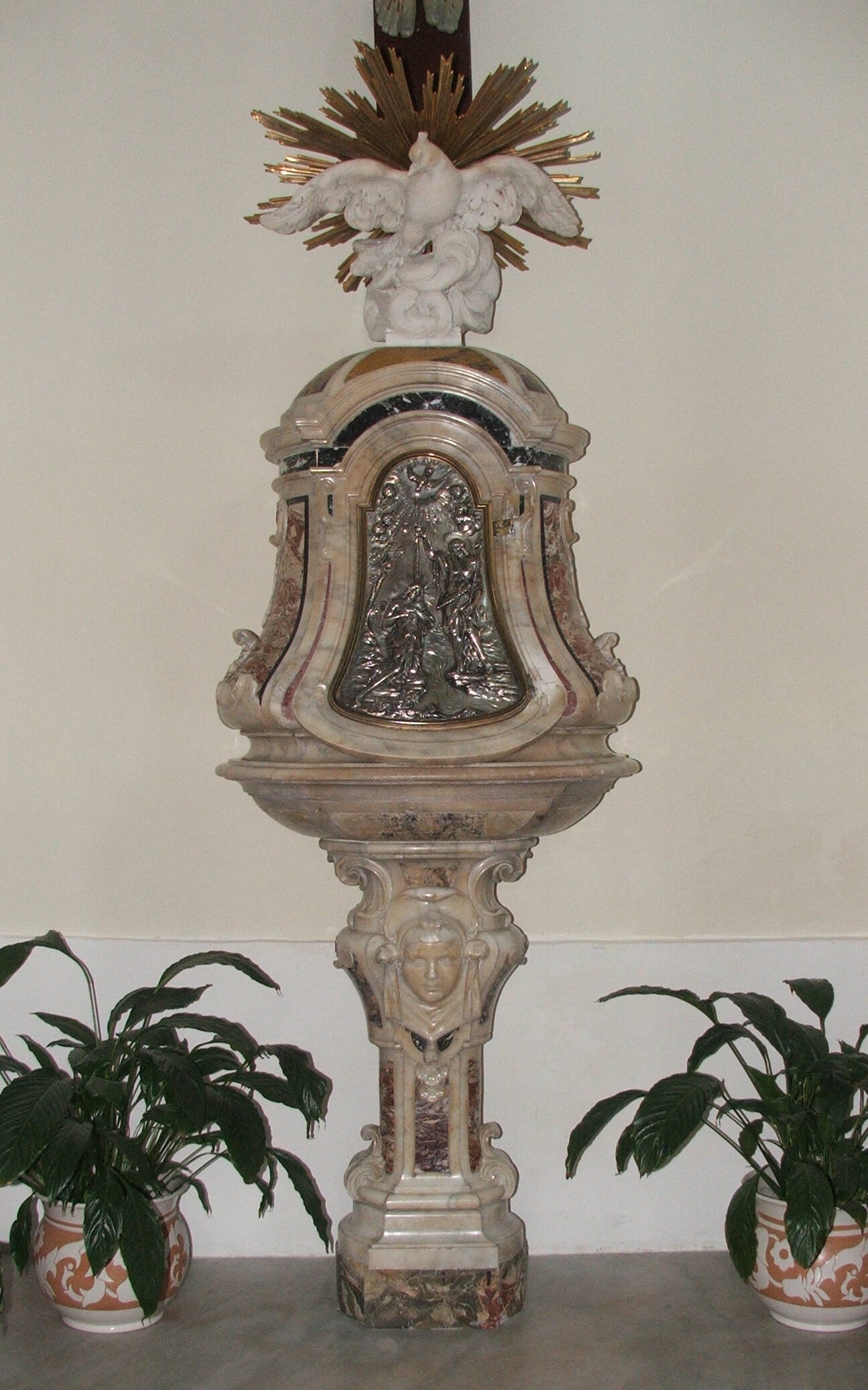
Nel 1761 l’arciprete Pietro Antonio Perillo, coordinatore della fabbrica della Chiesa di S. Maria Maggiore, firmò un contratto con Gaetano Amoroso, un capomastro stuccatore ed intagliatore di Miano, in cui si stabiliva che il maestro stuccatore avrebbe stuccato la crociera, realizzati gli altari e le sculture dell’edificio, poi avrebbe realizzato e intagliato il coro ligneo. Inoltre, l’Amoroso si impegnava a portare con sé lo scultore Nicola Massaro che avrebbe realizzato gli angeli e le ghirlande dei fiori.
I due artisti, inoltre, si prodigarono nella realizzazione della composizione del fonte battesimale e dell’altare maggiore che realizzarono in marmi policromi.
La perizia artistica dei due autori si vede soprattutto nella realizzazione della colomba dello Spirito Santo e nel volto della donna alla base del fonte.
In 1761 the archpriest Pietro Antonio Perillo, coordinator of the factory of the Church of S. Maria Maggiore, signed a contract with Gaetano Amoroso, a master plasterer and carver from Miano, in which it was established that the master plasterer would have puttied the cruise, made the altars and the sculptures of the building, then he would have made and carved the wooden choir. In addition, the Amoroso pledged to bring the sculptor Nicola Massaro with him who would have made the angels and the flower garlands.
The two artists also went out of their way to create the composition of the baptismal font and the high altar which they made of polychrome marble.
The artistic expertise of the two authors is seen above all in the realization of the dove of the Holy Spirit and in the face of the woman at the base of the source.

Chiesa di S. Maria Maggiore
Fonte Battesimale
Gaetano Amoroso e Nicola Massaro
Sec. XVIII (tra il 1761 e il 1763)
Marmi policromi

Church of S. Maria Maggiore
Baptismal font
Gaetano Amoroso and Nicola Massaro
18th century (between 1761 and 1763)
Polychrome marbles
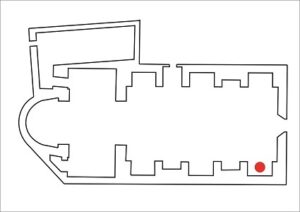
Nel 1761 l’arciprete Pietro Antonio Perillo, coordinatore della fabbrica della Chiesa di S. Maria Maggiore, firmò un contratto con Gaetano Amoroso, un capomastro stuccatore ed intagliatore di Miano, in cui si stabiliva che il maestro stuccatore avrebbe stuccato la crociera, realizzati gli altari e le sculture dell’edificio, poi avrebbe realizzato e intagliato il coro ligneo. Inoltre, l’Amoroso si impegnava a portare con sé lo scultore Nicola Massaro che avrebbe realizzato gli angeli e le ghirlande dei fiori.
I due artisti, inoltre, si prodigarono nella realizzazione della composizione del fonte battesimale e dell’altare maggiore che realizzarono in marmi policromi.
La perizia artistica dei due autori si vede soprattutto nella realizzazione della colomba dello Spirito Santo e nel volto della donna alla base del fonte.
In 1761 the archpriest Pietro Antonio Perillo, coordinator of the factory of the Church of S. Maria Maggiore, signed a contract with Gaetano Amoroso, a master plasterer and carver from Miano, in which it was established that the master plasterer would have puttied the cruise, made the altars and the sculptures of the building, then he would have made and carved the wooden choir. In addition, the Amoroso pledged to bring the sculptor Nicola Massaro with him who would have made the angels and the flower garlands.
The two artists also went out of their way to create the composition of the baptismal font and the high altar which they made of polychrome marble.
The artistic expertise of the two authors is seen above all in the realization of the dove of the Holy Spirit and in the face of the woman at the base of the source.
Chiesa di S. Maria Maggiore
Acquasantiera
Giuseppe Massa
Sec. XVIII (1769)
Maiolica

Church of S. Maria Maggiore
Stoup
Giuseppe Massa
18th century (1769)
Majolica
L’acquasantiera è opera del “reggiolaro”, o ceramista, Giuseppe Massa, figlio del noto Donato Massa, il quale, insieme al fratello più grande, Giuseppe, realizzò le decorazioni in maiolica del chiostro di S. Chiara a Napoli.
Nel 1769 i Massa realizzarono la pavimentazione in maiolica della chiesa e della sacrestia di S. Maria Maggiore. La decorazione del pavimento era caratterizzata da racemi e teste di angeli alati.
Negli anni ’50 del Novecento il pavimento venne sostituito perché consunto ma tracce delle maioliche settecentesche sono visibili nella cappella del Crocifisso e del Fonte Battesimale.
The stoup is the work of the “reggiolaro”, or ceramist, Giuseppe Massa, son of the well-known Donato Massa, who, together with his older brother, Giuseppe, created the majolica decorations of the cloister of S. Chiara in Naples.
In 1769 the Massa built the majolica flooring of the church and sacristy of S. Maria Maggiore. The floor decoration was characterized by racemes and heads of winged angels.
In the 50s of the twentieth century the floor was replaced because it was worn out but traces of the eighteenth-century majolica are visible in the chapel of the Crucifix and the Baptismal Font.

Chiesa di S. Maria Maggiore
Acquasantiera
Giuseppe Massa
Sec. XVIII (1769)
Maiolica

Church of S. Maria Maggiore
Stoup
Giuseppe Massa
18th century (1769)
Majolica
L’acquasantiera è opera del “reggiolaro”, o ceramista, Giuseppe Massa, figlio del noto Donato Massa, il quale, insieme al fratello più grande, Giuseppe, realizzò le decorazioni in maiolica del chiostro di S. Chiara a Napoli.
Nel 1769 i Massa realizzarono la pavimentazione in maiolica della chiesa e della sacrestia di S. Maria Maggiore. La decorazione del pavimento era caratterizzata da racemi e teste di angeli alati.
Negli anni ’50 del Novecento il pavimento venne sostituito perché consunto ma tracce delle maioliche settecentesche sono visibili nella cappella del Crocifisso e del Fonte Battesimale.
The stoup is the work of the “reggiolaro”, or ceramist, Giuseppe Massa, son of the well-known Donato Massa, who, together with his older brother, Giuseppe, created the majolica decorations of the cloister of S. Chiara in Naples.
In 1769 the Massa built the majolica flooring of the church and sacristy of S. Maria Maggiore. The floor decoration was characterized by racemes and heads of winged angels.
In the 50s of the twentieth century the floor was replaced because it was worn out but traces of the eighteenth-century majolica are visible in the chapel of the Crucifix and the Baptismal Font.
Chiesa di S. Maria Maggiore
Dipinto
San Domenico di Guzman
Sec. XVII (prima metà)
Olio su tela
Ambito culturale campano

Church of S. Maria Maggiore
Painting
San Domenico of Guzman
17th century (first half)
Oil painting on canvas
Campania cultural area
La tela in origine si trovava nella Chiesa del Rosario, annessa convento domenicano fondato durante la metà del XVI secolo e chiuso per mancanza di rendite nel 1652.
L’opera era posta sull’altare dedicato a San Domenico, secondo la regola dell’Ordine che stabiliva che in tutte le chiese annesse ai conventi domenicani dovesse esserci un altare e un immagine del santo fondatore dell’Ordine.
Dopo la chiusura del convento la tela venne trasferita nella chiesa madre e, in seguito alla ricostruzione settecentesca, la tela venne alloggiata prima in una delle cappelle laterali e poi nella sacrestia vecchia.
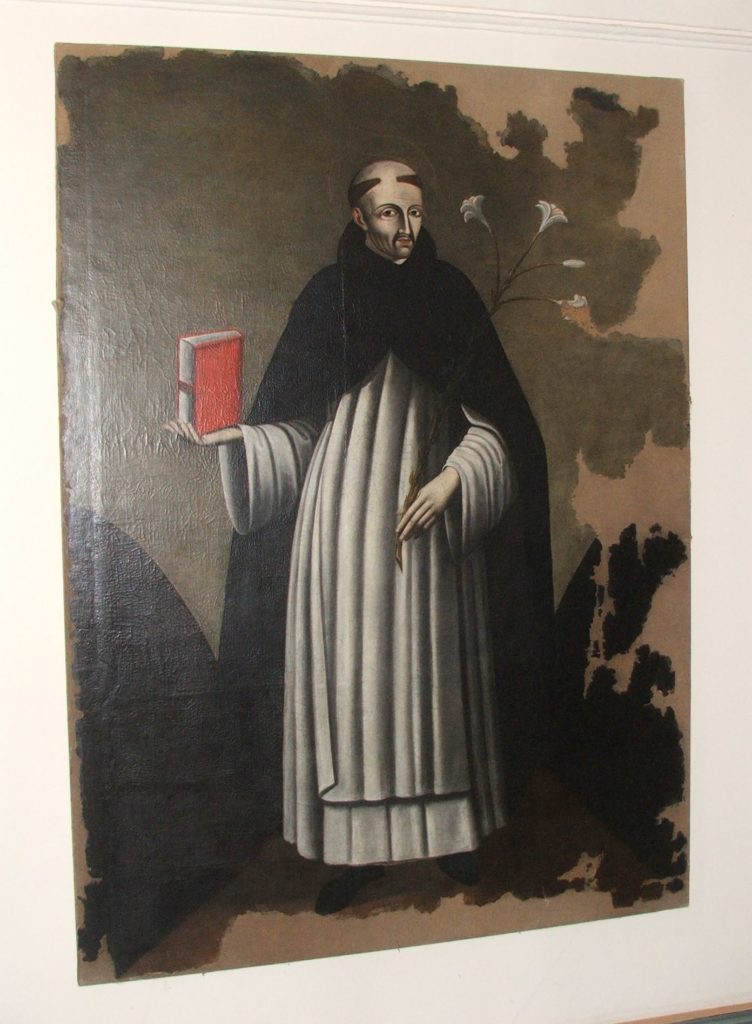
L’opera rappresenta S. Domenico di Guzman visto frontalmente nell’atto di sorregge nella mano destra un libro sacro e nella sinistra un giglio.
Non è documentato l’autore del dipinto, ma è ben noto il modello iconografico: l’immagine miracolosa del San Domenico di Soriano Calabro, una tela del XV secolo che funge da riferimento per svariate raffigurazioni di San Domenico.
The canvas was originally located in the Church of the Rosary, an annexed Dominican convent founded during the mid-sixteenth century and closed due to lack of income in 1652.
The work was placed on the altar dedicated to San Domenico, according to the rule of the Order which established that in all the churches annexed to the Dominican convents there should be an altar and an image of the holy founder of the Order.
After the convent was closed, the canvas was transferred to the Mother Church and, following the eighteenth-century reconstruction, the canvas was housed first in one of the side chapels and then in the old sacristy.
The work represents S. Domenico di Guzman seen frontally in the act of holding up a holy book in the right hand and a lily in the left.
The author of the painting is not documented, but the iconographic model is well known: the miraculous image of San Domenico by Soriano Calabro, a 15th-century canvas that serves as a reference for various representations of San Domenico.

Chiesa di S. Maria Maggiore
Dipinto
San Domenico di Guzman
Sec. XVII (prima metà)
Olio su tela
Ambito culturale campano

Church of S. Maria Maggiore
Painting
San Domenico of Guzman
17th century (first half)
Oil painting on canvas
Campania cultural area
La tela in origine si trovava nella Chiesa del Rosario, annessa convento domenicano fondato durante la metà del XVI secolo e chiuso per mancanza di rendite nel 1652.
L’opera era posta sull’altare dedicato a San Domenico, secondo la regola dell’Ordine che stabiliva che in tutte le chiese annesse ai conventi domenicani dovesse esserci un altare e un immagine del santo fondatore dell’Ordine.
Dopo la chiusura del convento la tela venne trasferita nella chiesa madre e, in seguito alla ricostruzione settecentesca, la tela venne alloggiata prima in una delle cappelle laterali e poi nella sacrestia vecchia.
L’opera rappresenta S. Domenico di Guzman visto frontalmente nell’atto di sorregge nella mano destra un libro sacro e nella sinistra un giglio.
Non è documentato l’autore del dipinto, ma è ben noto il modello iconografico: l’immagine miracolosa del San Domenico di Soriano Calabro, una tela del XV secolo che funge da riferimento per svariate raffigurazioni di San Domenico.
The canvas was originally located in the Church of the Rosary, an annexed Dominican convent founded during the mid-sixteenth century and closed due to lack of income in 1652.
The work was placed on the altar dedicated to San Domenico, according to the rule of the Order which established that in all the churches annexed to the Dominican convents there should be an altar and an image of the holy founder of the Order.
After the convent was closed, the canvas was transferred to the Mother Church and, following the eighteenth-century reconstruction, the canvas was housed first in one of the side chapels and then in the old sacristy.
The work represents S. Domenico di Guzman seen frontally in the act of holding up a holy book in the right hand and a lily in the left.
The author of the painting is not documented, but the iconographic model is well known: the miraculous image of San Domenico by Soriano Calabro, a 15th-century canvas that serves as a reference for various representations of San Domenico.
The fresco signed “… Vigilante 1781” was commissioned by the archpriest Pietro Antonio Perillo who added the inscription to the base: “P.A.P. ex voto “, or” Pietro Antonio Perillo by vote”, “or following a vote“. This phrase, together with the other “discite posteri” and “In anathemate oblivionis“, always written on the painting, form the last message of the archpriest who urges the visitor not to forget the work he created: “Imparate posteri, [me that I built this temple I am] nella maledizione dell’oblio“.
The fresco represents the reconstruction of the walls of Jerusalem by Nehemiah, after the sacking of the city by the Persians.

Chiesa di S. Maria Maggiore
Altare
Matteo Vigilante
La ricostruzione delle mura di Gerusalemme
Sec. XVIII (dat. 1781)
Affresco

Chiesa di S. Maria Maggiore
Painting
Matteo Vigilante
The reconstruction of the walls of Jerusalem
XVIII century (date 1781)
Fresco
L’affresco firmato “… Vigilante 1781” fu commissionato dall’arciprete Pietro Antonio Perillo che, alla base fece aggiungere l’iscrizione : “P.A.P. ex voto”, ovvero “Pietro Antonio Perillo per voto” o “a seguito di un voto”. Questa frase, unita alle altre “discite posteri” e “In anathemate oblivionis”, sempre riportate sul dipinto, formano l’ultimo messaggio dell’arciprete che scongiura il visitatore di non dimenticare l’opera da lui realizzata: “Imparate posteri, [io che ho costruito questo tempio sono] nella maledizione dell’oblio”.
L’affresco rappresenta la ricostruzione delle mura di Gerusalemme da parte di Neemia, dopo il saccheggio della città da parte dei Persiani.
The fresco signed “… Vigilante 1781” was commissioned by the archpriest Pietro Antonio Perillo who added the inscription to the base: “P.A.P. ex voto “, or” Pietro Antonio Perillo by vote”, “or following a vote“. This phrase, together with the other “discite posteri” and “In anathemate oblivionis“, always written on the painting, form the last message of the archpriest who urges the visitor not to forget the work he created: “Imparate posteri, [me that I built this temple I am] nella maledizione dell’oblio“.
The fresco represents the reconstruction of the walls of Jerusalem by Nehemiah, after the sacking of the city by the Persians.
Chiesa di S. Maria Maggiore
Dipinto
Matteo (o Tommaso) Vigilante
Puttino con palma e medaglione
Sec. XVIII (seconda metà)
Olio su tela

Church of S. Maria Maggiore
Painting
Matteo (or Tommaso) Vigilante
Cherub with palm tree and medallion
18th century (second half)
Oil painting on canvas
L’opera fa parte di una serie di quattro ovali, commissionati dall’arciprete Pietro Antonio Perillo, parroco di Grottaminarda dal 1748 al 1796 e promotore della ricostruzione della Chiesa di S. Maria Maggiore.
Tutti e quattro gli ovali rappresentano un puttino e tre di questi sorreggono un medaglione ovale in cui sono riportate citazioni della Bibbia. Le citazioni furono scelte, secondo la tradizione, dallo stesso arciprete Perillo, che attraverso di esse lasciò un messaggio a chi visitava la chiesa, quasi una sorta di testamento spirituale.
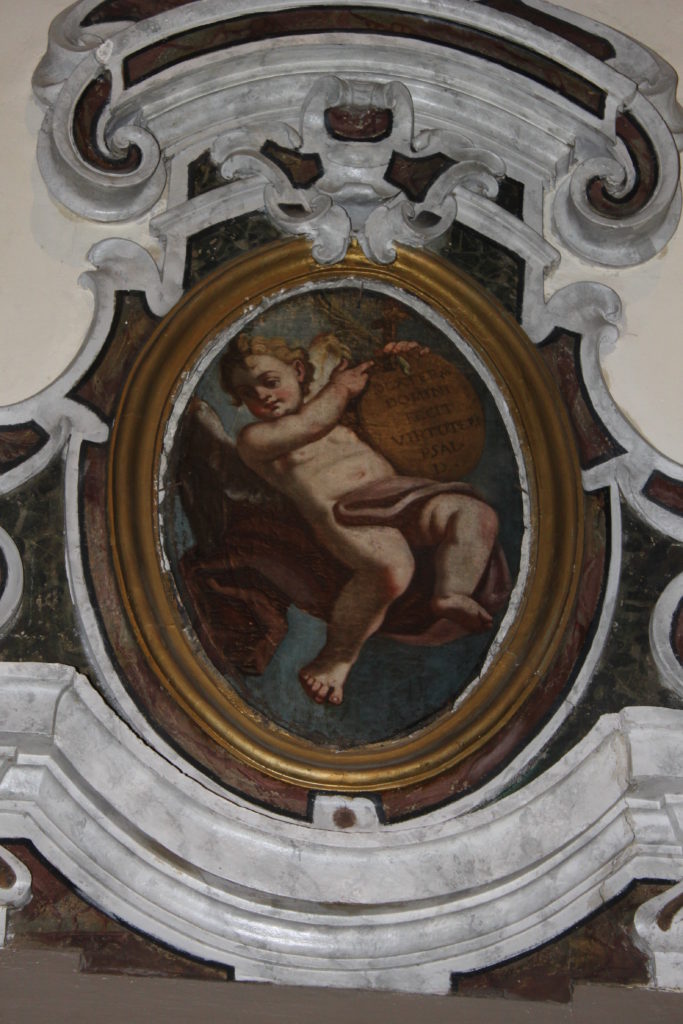
In questo ovale il puttino regge, con entrambe le mani, un medaglione con l’iscrizione “dextera Domini fecit virtutem”, un motto preso dal Salmo 117, verso 16 della Vulgata, che tradotto dice: “La destra del Signore ha fatto meraviglie”.
È un chiaro riferimento all’opera fatta dall’arciprete, che confidando nell’aiuto del Signore è riuscito a realizzare il “meraviglioso” tempio monumentale.
The work is part of a series of four ovals, commissioned by the archpriest Pietro Antonio Perillo, parish priest of Grottaminarda from 1748 to 1796 and promoter of the reconstruction of the Church of S. Maria Maggiore.
All four ovals represent a cherub and three of these support an oval medallion in which quotations from the Bible are reported. According to tradition, the quotes were chosen by the archpriest Perillo himself, who through them left a message to those who visited the church, almost a sort of spiritual testament.
In this oval the cherub holds, with both hands, a medallion with the inscription “dextera Domini fecit virtutem“, a motto taken from Psalm 117, verse 16 of the Vulgate, which translated says: “The right hand of the Lord has done wonders“.
It is a clear reference to the work done by the archpriest, who, trusting in the help of the Lord, managed to create the “wonderful” monumental temple.

Chiesa di S. Maria Maggiore
Dipinto
Matteo (o Tommaso) Vigilante
Puttino con palma e medaglione
Sec. XVIII (seconda metà)
Olio su tela

Church of S. Maria Maggiore
Painting
Matteo (or Tommaso) Vigilante
Cherub with palm tree and medallion
18th century (second half)
Oil painting on canvas
L’opera fa parte di una serie di quattro ovali, commissionati dall’arciprete Pietro Antonio Perillo, parroco di Grottaminarda dal 1748 al 1796 e promotore della ricostruzione della Chiesa di S. Maria Maggiore.
Tutti e quattro gli ovali rappresentano un puttino e tre di questi sorreggono un medaglione ovale in cui sono riportate citazioni della Bibbia. Le citazioni furono scelte, secondo la tradizione, dallo stesso arciprete Perillo, che attraverso di esse lasciò un messaggio a chi visitava la chiesa, quasi una sorta di testamento spirituale.
In questo ovale il puttino regge, con entrambe le mani, un medaglione con l’iscrizione “dextera Domini fecit virtutem”, un motto preso dal Salmo 117, verso 16 della Vulgata, che tradotto dice: “La destra del Signore ha fatto meraviglie”.
È un chiaro riferimento all’opera fatta dall’arciprete, che confidando nell’aiuto del Signore è riuscito a realizzare il “meraviglioso” tempio monumentale.
The work is part of a series of four ovals, commissioned by the archpriest Pietro Antonio Perillo, parish priest of Grottaminarda from 1748 to 1796 and promoter of the reconstruction of the Church of S. Maria Maggiore.
All four ovals represent a cherub and three of these support an oval medallion in which quotations from the Bible are reported. According to tradition, the quotes were chosen by the archpriest Perillo himself, who through them left a message to those who visited the church, almost a sort of spiritual testament.
In this oval the cherub holds, with both hands, a medallion with the inscription “dextera Domini fecit virtutem“, a motto taken from Psalm 117, verse 16 of the Vulgate, which translated says: “The right hand of the Lord has done wonders“.
It is a clear reference to the work done by the archpriest, who, trusting in the help of the Lord, managed to create the “wonderful” monumental temple.
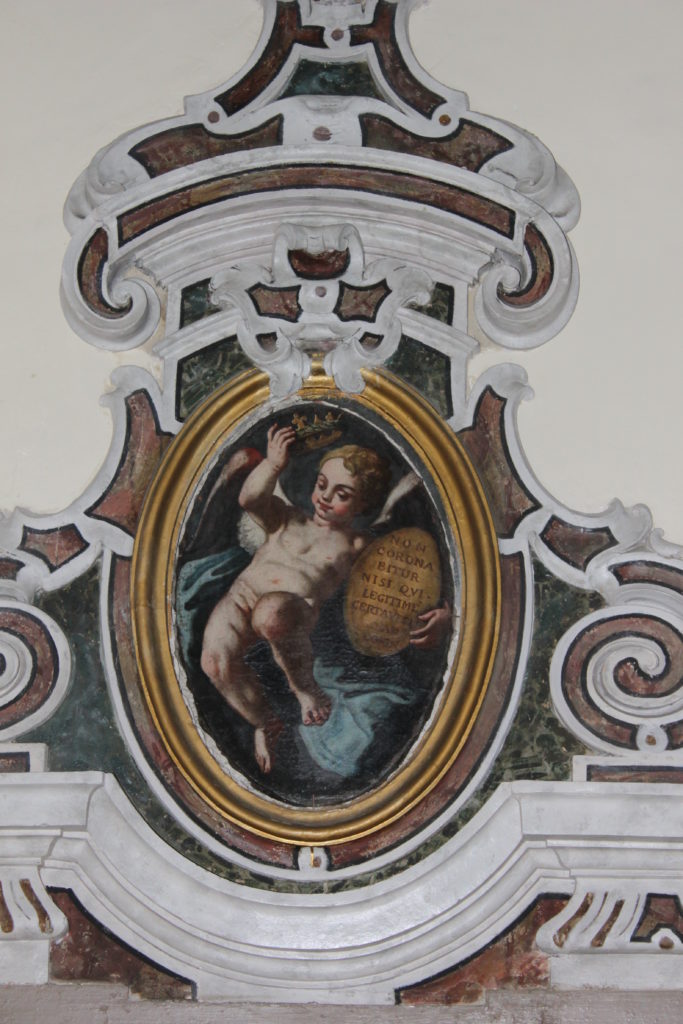
Chiesa di S. Maria Maggiore
Dipinto
Matteo (or Tommaso) Vigilante
Puttino con corona e medaglione
Sec. XVIII (seconda metà)
Olio su tela

Church of S. Maria Maggiore
Painting
Matteo (or Tommaso) Vigilante
Cherub with crown and medallion
18th century (second half)
Oil painting on canvas
L’opera fa parte di una serie di quattro ovali, commissionati dall’arciprete Pietro Antonio Perillo, parroco di Grottaminarda dal 1748 al 1796 e promotore della ricostruzione della Chiesa di S. Maria Maggiore.
Tutti e quattro gli ovali rappresentano un puttino e tre di questi sorreggono un medaglione ovale in cui sono riportate citazioni della Bibbia. Le citazioni furono scelte, secondo la tradizione, dallo stesso arciprete Perillo, che attraverso di esse lasciò un messaggio a chi visitava la chiesa, quasi una sorta di testamento spirituale.
Il puttino nella mano destra sorregge una corona che si porta al capo e nella sinistra un medaglione ovale su cui è dipinta la citazione biblica: “non coronabitur, nisi qui legittime certaverit”, tratta dalla Vulgata e in particolare dalla Seconda Lettera di San Paolo a Timoteo (2,5), « Non riceve la corona se non chi ha lottato secondo le regole/ “non sarà coronato se non colui, che legittimamente combatterà”».
Il passo dovrebbe alludere alle controversie che l’arciprete ebbe con il duca Coscia, feudatario di Grottaminarda e finanziatore della fabbrica della chiesa. Il duca accusava l’arciprete di non utilizzare le somme che gli dava per il completamento dell’edifico sacro. L’arciprete fu costretto a difendersi più volte da queste accuse, portando in giudizio il duca e dimostrando, con regolari ricevute, che tutti i soldi venivano spesi solo per la costruzione dell’edificio.
The work is part of a series of four ovals, commissioned by the archpriest Pietro Antonio Perillo, parish priest of Grottaminarda from 1748 to 1796 and promoter of the reconstruction of the Church of S. Maria Maggiore.
All four ovals represent a cherub and three of these support an oval medallion in which quotations from the Bible are reported. According to tradition, the quotations were chosen by the same archpriest Perillo, who through them left a message to those who visited the church, almost a sort of spiritual testament.
The little putti in his right hand holds a crown which carries an oval medallion on his head and on his left a biblical quote on which the biblical quotation is painted: “non coronabitur, nisi qui legitime certiverit“, taken from the Vulgate and in particular from the Second Letter of Saint Paul to Timothy (2,5), «He does not receive the crown except he who has fought according to the rules / “it will not be crowned if not the one who legitimately will fight”.
The passage should allude to the controversies that the archpriest had with Duke Coscia, feudal lord of Grottaminarda and financier of the church factory. The duke accused the archpriest of not using the sums he gave him for the completion of the sacred building. The archpriest was forced to defend himself several times against these accusations, bringing the duke to trial and demonstrating, with regular receipts, that all the money was spent only on the construction of the building.

Chiesa di S. Maria Maggiore
Dipinto
Matteo (or Tommaso) Vigilante
Puttino con corona e medaglione
Sec. XVIII (seconda metà)
Olio su tela

Church of S. Maria Maggiore
Painting
Matteo (or Tommaso) Vigilante
Cherub with crown and medallion
18th century (second half)
Oil painting on canvas
L’opera fa parte di una serie di quattro ovali, commissionati dall’arciprete Pietro Antonio Perillo, parroco di Grottaminarda dal 1748 al 1796 e promotore della ricostruzione della Chiesa di S. Maria Maggiore.
Tutti e quattro gli ovali rappresentano un puttino e tre di questi sorreggono un medaglione ovale in cui sono riportate citazioni della Bibbia. Le citazioni furono scelte, secondo la tradizione, dallo stesso arciprete Perillo, che attraverso di esse lasciò un messaggio a chi visitava la chiesa, quasi una sorta di testamento spirituale.
Il puttino nella mano destra sorregge una corona che si porta al capo e nella sinistra un medaglione ovale su cui è dipinta la citazione biblica: “non coronabitur, nisi qui legittime certaverit”, tratta dalla Vulgata e in particolare dalla Seconda Lettera di San Paolo a Timoteo (2,5), « Non riceve la corona se non chi ha lottato secondo le regole/ “non sarà coronato se non colui, che legittimamente combatterà”».
Il passo dovrebbe alludere alle controversie che l’arciprete ebbe con il duca Coscia, feudatario di Grottaminarda e finanziatore della fabbrica della chiesa. Il duca accusava l’arciprete di non utilizzare le somme che gli dava per il completamento dell’edifico sacro. L’arciprete fu costretto a difendersi più volte da queste accuse, portando in giudizio il duca e dimostrando, con regolari ricevute, che tutti i soldi venivano spesi solo per la costruzione dell’edificio.
The work is part of a series of four ovals, commissioned by the archpriest Pietro Antonio Perillo, parish priest of Grottaminarda from 1748 to 1796 and promoter of the reconstruction of the Church of S. Maria Maggiore.
All four ovals represent a cherub and three of these support an oval medallion in which quotations from the Bible are reported. According to tradition, the quotations were chosen by the same archpriest Perillo, who through them left a message to those who visited the church, almost a sort of spiritual testament.
The little putti in his right hand holds a crown which carries an oval medallion on his head and on his left a biblical quote on which the biblical quotation is painted: “non coronabitur, nisi qui legitime certiverit“, taken from the Vulgate and in particular from the Second Letter of Saint Paul to Timothy (2,5), «He does not receive the crown except he who has fought according to the rules / “it will not be crowned if not the one who legitimately will fight”.
The passage should allude to the controversies that the archpriest had with Duke Coscia, feudal lord of Grottaminarda and financier of the church factory. The duke accused the archpriest of not using the sums he gave him for the completion of the sacred building. The archpriest was forced to defend himself several times against these accusations, bringing the duke to trial and demonstrating, with regular receipts, that all the money was spent only on the construction of the building.
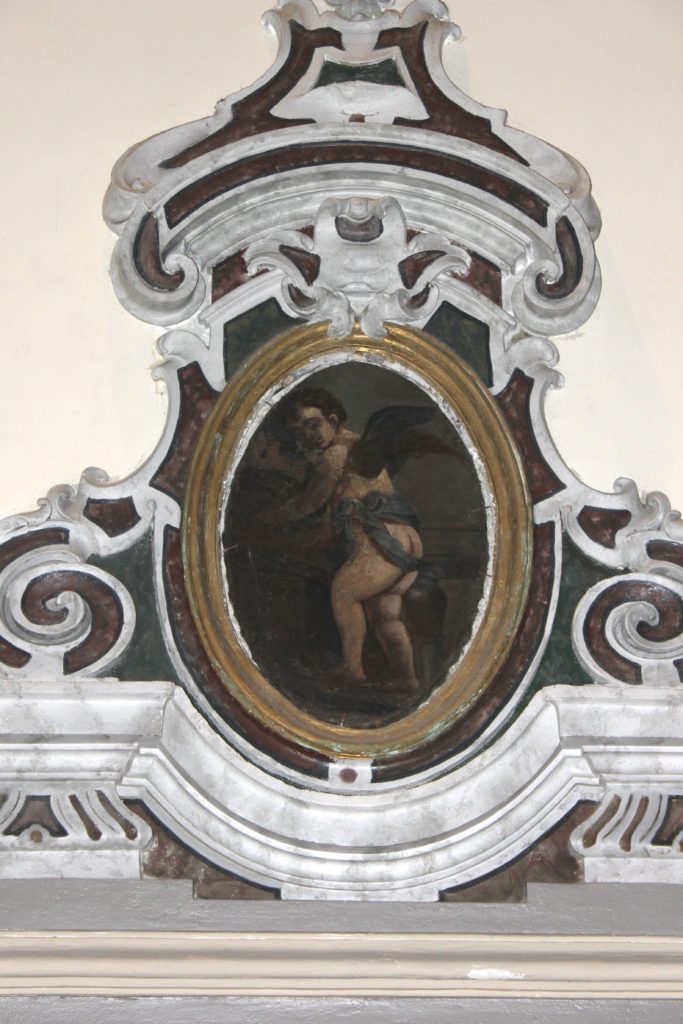
Chiesa di S. Maria Maggiore
Dipinto
Matteo (or Tommaso) Vigilante
Puttino organista
Sec. XVIII (seconda metà)
Olio su tela

Church of S. Maria Maggiore
Painting
Matteo (or Tommaso) Vigilante
Organist cherub
18th century (second half)
Oil painting on canvas
L’opera fa parte di una serie di quattro ovali, commissionati dall’arciprete Pietro Antonio Perillo, parroco di Grottaminarda dal 1748 al 1796 e promotore della ricostruzione della Chiesa di S. Maria Maggiore.
Tutti e quattro gli ovali rappresentano un puttino e tre di questi sorreggono un medaglione ovale in cui sono dipinte delle iscrizioni che riportano citazioni della Bibbia. Le citazioni furono scelte, secondo la tradizione, dallo stesso arciprete Perillo, che attraverso di esse lasciò un messaggio a chi visitava la chiesa, quasi una sorta di testamento spirituale.
Il dipinto, l’unico senza iscrizione, rappresenta un puttino intento a suonare l’organo, forse l’allusione al fatto che fu lo stesso arciprete a finanziare la costruzione dell’organo della chiesa.
The work is part of a series of four ovals, commissioned by the archpriest Pietro Antonio Perillo, parish priest of Grottaminarda from 1748 to 1796 and promoter of the reconstruction of the Church of S. Maria Maggiore.
All four ovals represent a cherub and three of these support an oval medallion in which inscriptions are painted with quotations from the Bible. According to tradition, the quotes were chosen by the archpriest Perillo himself, who through them left a message to those who visited the church, almost a sort of spiritual testament.
The painting, the only one without an inscription, represents a cherub intent on playing the organ, perhaps the allusion to the fact that it was the archpriest himself who financed the construction of the church organ.

Chiesa di S. Maria Maggiore
Dipinto
Matteo (or Tommaso) Vigilante
Puttino organista
Sec. XVIII (seconda metà)
Olio su tela

Church of S. Maria Maggiore
Painting
Matteo (or Tommaso) Vigilante
Organist cherub
18th century (second half)
Oil painting on canvas
L’opera fa parte di una serie di quattro ovali, commissionati dall’arciprete Pietro Antonio Perillo, parroco di Grottaminarda dal 1748 al 1796 e promotore della ricostruzione della Chiesa di S. Maria Maggiore.
Tutti e quattro gli ovali rappresentano un puttino e tre di questi sorreggono un medaglione ovale in cui sono dipinte delle iscrizioni che riportano citazioni della Bibbia. Le citazioni furono scelte, secondo la tradizione, dallo stesso arciprete Perillo, che attraverso di esse lasciò un messaggio a chi visitava la chiesa, quasi una sorta di testamento spirituale.
Il dipinto, l’unico senza iscrizione, rappresenta un puttino intento a suonare l’organo, forse l’allusione al fatto che fu lo stesso arciprete a finanziare la costruzione dell’organo della chiesa.
The work is part of a series of four ovals, commissioned by the archpriest Pietro Antonio Perillo, parish priest of Grottaminarda from 1748 to 1796 and promoter of the reconstruction of the Church of S. Maria Maggiore.
All four ovals represent a cherub and three of these support an oval medallion in which inscriptions are painted with quotations from the Bible. According to tradition, the quotes were chosen by the archpriest Perillo himself, who through them left a message to those who visited the church, almost a sort of spiritual testament.
The painting, the only one without an inscription, represents a cherub intent on playing the organ, perhaps the allusion to the fact that it was the archpriest himself who financed the construction of the church organ.
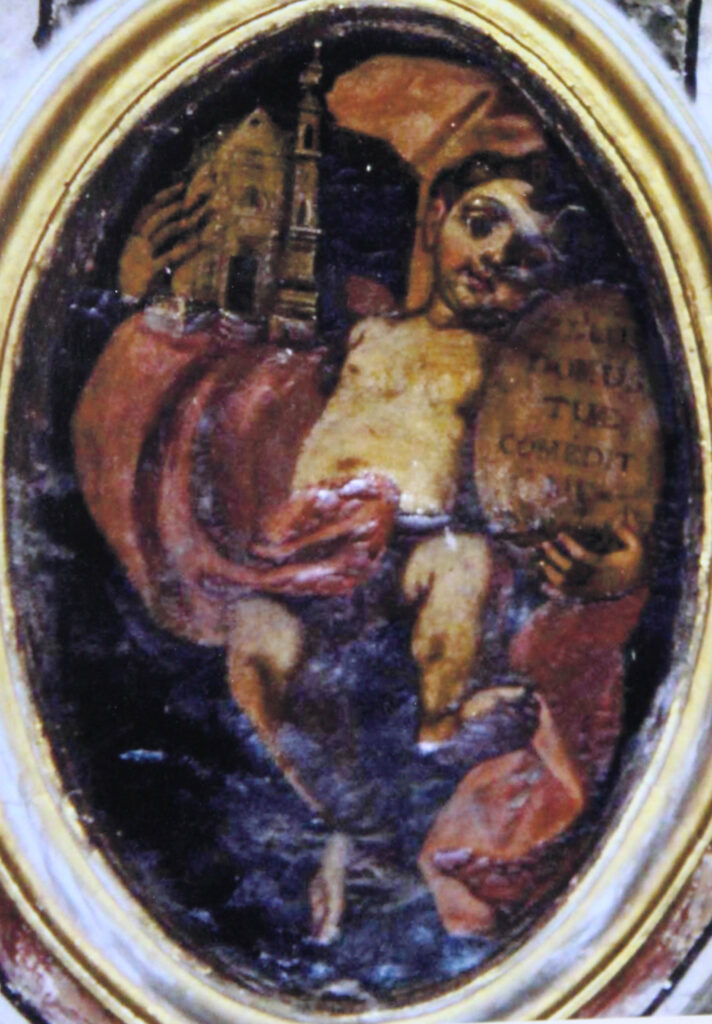
Chiesa di S. Maria Maggiore
Stampa
Matteo Vigilante
Puttino con modello della chiesa e medaglione
Sec. XXI
Stampa tipografica

Church of S. Maria Maggiore
Painting
Matteo Vigilante
Cherub with palm tree and medallion
21th century
Typographical printing
L’opera fa parte di una serie di quattro ovali, commissionati dall’arciprete Pietro Antonio Perillo, parroco di Grottaminarda dal 1748 al 1796 e promotore della ricostruzione della Chiesa di S. Maria Maggiore.
Tutti e quattro gli ovali rappresentano un puttino e tre di questi sorreggono un medaglione ovale in cui sono riportate delle citazioni della Bibbia. Le citazioni furono scelte, secondo la tradizione, dallo stesso arciprete Perillo, che attraverso di esse lasciò un messaggio a chi visitava la chiesa, quasi una sorta di testamento spirituale.
Il puttino, con la destra sorregge il modellino della chiesa stessa e con la sinistra un medaglione in cui è riportata la citazione latina “zelus domus tuae comedit me”, presa dalla Vulgata, dal salmo 68, verso 10, che tradotto dice: “Lo zelo della tua casa mi ha consumato”. Con un chiaro riferimento ai costi e alla cura dispendiosa del sacro edificio.
Purtroppo l’opera non è originale ma solo una copia tipografica. L’originale venne trafugato all’inizio degli anni ‘90 del Novecento.
The work is part of a series of four ovals, commissioned by the archpriest Pietro Antonio Perillo, parish priest of Grottaminarda from 1748 to 1796 and promoter of the reconstruction of the Church of S. Maria Maggiore.
All four ovals represent a cherub and three of these support an oval medallion in which are quoted from the Bible. According to tradition, the quotations were chosen by the same archpriest Perillo, who through them left a message to those who visited the church, almost a sort of spiritual testament.
The puttino, with his right hand, holds the model of the church itself and with his left a medallion which contains the Latin quote “zelus domus tuae comedit me“, taken from the Vulgate, from Psalm 68, verse 10, which translated says: “The zeal of your house has consumed me“. With a clear reference to the costs and costly care of the sacred building.
Unfortunately, the work is not original but only a letterpress copy. The original was stolen in the early 90s of the twentieth century.

Chiesa di S. Maria Maggiore
Stampa
Matteo Vigilante
Puttino con modello della chiesa e medaglione
Sec. XXI
Stampa tipografica

Church of S. Maria Maggiore
Painting
Matteo Vigilante
Cherub with palm tree and medallion
21th century
Typographical printing
L’opera fa parte di una serie di quattro ovali, commissionati dall’arciprete Pietro Antonio Perillo, parroco di Grottaminarda dal 1748 al 1796 e promotore della ricostruzione della Chiesa di S. Maria Maggiore.
Tutti e quattro gli ovali rappresentano un puttino e tre di questi sorreggono un medaglione ovale in cui sono riportate delle citazioni della Bibbia. Le citazioni furono scelte, secondo la tradizione, dallo stesso arciprete Perillo, che attraverso di esse lasciò un messaggio a chi visitava la chiesa, quasi una sorta di testamento spirituale.
Il puttino, con la destra sorregge il modellino della chiesa stessa e con la sinistra un medaglione in cui è riportata la citazione latina “zelus domus tuae comedit me”, presa dalla Vulgata, dal salmo 68, verso 10, che tradotto dice: “Lo zelo della tua casa mi ha consumato”. Con un chiaro riferimento ai costi e alla cura dispendiosa del sacro edificio.
Purtroppo l’opera non è originale ma solo una copia tipografica. L’originale venne trafugato all’inizio degli anni ‘90 del Novecento.
The work is part of a series of four ovals, commissioned by the archpriest Pietro Antonio Perillo, parish priest of Grottaminarda from 1748 to 1796 and promoter of the reconstruction of the Church of S. Maria Maggiore.
All four ovals represent a cherub and three of these support an oval medallion in which are quoted from the Bible. According to tradition, the quotations were chosen by the same archpriest Perillo, who through them left a message to those who visited the church, almost a sort of spiritual testament.
The puttino, with his right hand, holds the model of the church itself and with his left a medallion which contains the Latin quote “zelus domus tuae comedit me“, taken from the Vulgate, from Psalm 68, verse 10, which translated says: “The zeal of your house has consumed me“. With a clear reference to the costs and costly care of the sacred building.
Unfortunately, the work is not original but only a letterpress copy. The original was stolen in the early 90s of the twentieth century.
Chiesa di S. Maria Maggiore
Dipinto
Estasi di Santa Teresa d’Avila
Sec. XVIII
Olio su tela
Ambito campano

Church of S. Maria Maggiore
Painting
Ecstasy of San Teresa d’Avila
XVIII century
Oil painting on canvas
Campania area
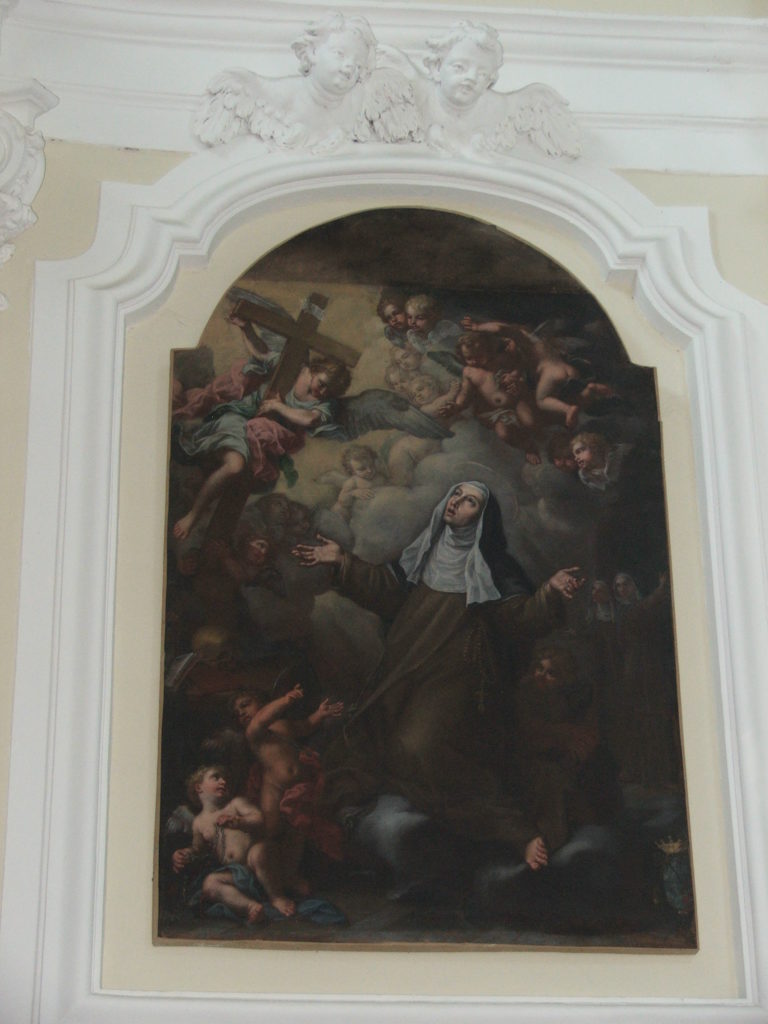
Non è nota la collocazione originaria dell’opera, sappiamo solo che, insieme al “San Michele” e al “Sant’Antonio di Padova”, durante i primi decenni del Novecento, era conservata in una delle cappelle laterali della navata.
Non si hanno notizie documentate sulla committenza, tuttavia l’opera in basso a destra, riporta lo stemma combinato della famiglia Coscia e Visconti, sui cui è poggiato un cappello prelatizio, ovvero un copricapo a tesa larga con due cordoni laterali rifiniti da una nappa. Lo stemma descritto attesta che l’opera fu commissionata da un ecclesiastico appartenente alla famiglia CosciaVisconti, forse un figlio di Raffaele Coscia e di Paola Visconti, che intraprese la carriera ecclesiastica.
L’opera, raffigurante l’estasi di S. Teresa d’Avila, fu vista e analizzata dal noto poeta Pietro Paolo Parzanese che la descrisse in suo articolo all’inizio dell’Ottocento.
The original location of the work is not known, we only know that, together with the “San Michele” and “Sant’Antonio di Padova“, during the first decades of the twentieth century, it was kept in one of the side chapels of the nave.
There is no documented information on the client, however the work at the bottom right, shows the combined coat of arms of the Coscia and Visconti family, on which a prelatice hat rests, or a wide-brimmed headdress with two side cords finished with a tassel. The coat of arms described attests that the work was commissioned by an ecclesiastic belonging to the Coscia-Visconti family, perhaps a son of Raffaele Coscia and Paola Visconti, who undertook an ecclesiastical career.
The work, depicting the ecstasy of St. Teresa of Avila, was seen and analyzed by the well-known poet Pietro Paolo Parzanese who described it in his article at the beginning of the nineteenth century.

Chiesa di S. Maria Maggiore
Dipinto
Estasi di Santa Teresa d’Avila
Sec. XVIII
Olio su tela
Ambito campano

Church of S. Maria Maggiore
Painting
Ecstasy of San Teresa d’Avila
XVIII century
Oil painting on canvas
Campania area
Non è nota la collocazione originaria dell’opera, sappiamo solo che, insieme al “San Michele” e al “Sant’Antonio di Padova”, durante i primi decenni del Novecento, era conservata in una delle cappelle laterali della navata.
Non si hanno notizie documentate sulla committenza, tuttavia l’opera in basso a destra, riporta lo stemma combinato della famiglia Coscia e Visconti, sui cui è poggiato un cappello prelatizio, ovvero un copricapo a tesa larga con due cordoni laterali rifiniti da una nappa. Lo stemma descritto attesta che l’opera fu commissionata da un ecclesiastico appartenente alla famiglia CosciaVisconti, forse un figlio di Raffaele Coscia e di Paola Visconti, che intraprese la carriera ecclesiastica.
L’opera, raffigurante l’estasi di S. Teresa d’Avila, fu vista e analizzata dal noto poeta Pietro Paolo Parzanese che la descrisse in suo articolo all’inizio dell’Ottocento.
The original location of the work is not known, we only know that, together with the “San Michele” and “Sant’Antonio di Padova“, during the first decades of the twentieth century, it was kept in one of the side chapels of the nave.
There is no documented information on the client, however the work at the bottom right, shows the combined coat of arms of the Coscia and Visconti family, on which a prelatice hat rests, or a wide-brimmed headdress with two side cords finished with a tassel. The coat of arms described attests that the work was commissioned by an ecclesiastic belonging to the Coscia-Visconti family, perhaps a son of Raffaele Coscia and Paola Visconti, who undertook an ecclesiastical career.
The work, depicting the ecstasy of St. Teresa of Avila, was seen and analyzed by the well-known poet Pietro Paolo Parzanese who described it in his article at the beginning of the nineteenth century.
Chiesa di S. Maria Maggiore
Dipinto
San Michele Arcangelo
Sec. XVII
Olio su tela
Ambito culturale campano

Church of S. Maria Maggiore
Painting
Archangel Michael
17th century
Oil painting on canvas
Campania cultural area
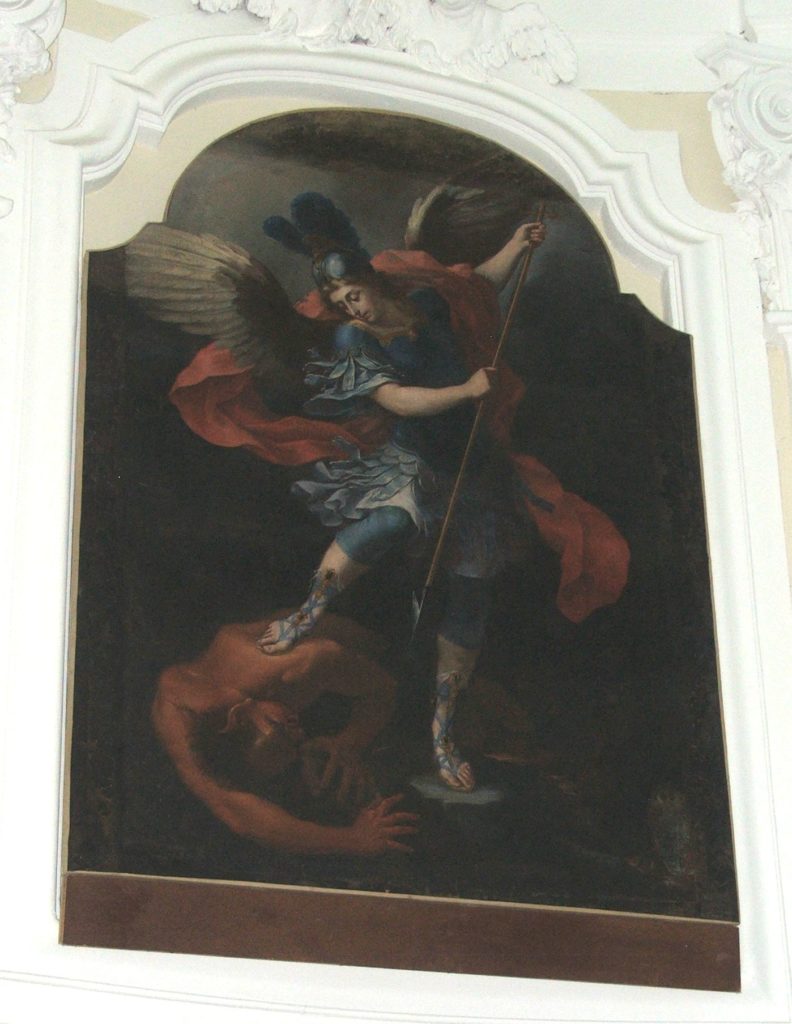
Il dipinto è parte della serie di otto tele scomparse dalla chiesa negli anni ’40 del XX secolo e riportata a Grottaminarda nel gennaio 1994.
E’ probabile che l’opera per il suo tema iconografico, San Michele arcangelo che sconfigge il demonio, fosse parte del patrimonio dell’omonima chiesa sino all’ultimo quarto del XVII secolo.
Dopo il terremoto del 1732, l’opera venne trasferita nella Chiesa di S. Maria Maggiore. Durante i primi decenni del Novecento, insieme a “S. Teresa” e a “Sant’Antonio di Padova”, era conservata in una delle cappelle laterali della navata. In seguito ai restauri, voluti dall’arciprete Alfonso Maria Cogliani, le opere vennero trasferite prima nella casa canonica e poi in sacrestia.
Non si hanno notizie documentate sulla committenza, tuttavia l’opera in basso a destra, riporta lo stemma combinato della famiglia Coscia e Visconti, sui cui è poggiato un cappello prelatizio. Probabilmente, potrebbe essere un figlio di Raffaele Coscia e di Paola Visconti che intraprese la carriera ecclesiastica.
Con buona probabilità questo ecclesiastico commissionò il restauro di questa tela e la realizzazione delle altre due tele citate.
The painting is part of the series of eight paintings that disappeared from the church in the 1940s and brought back to Grottaminarda in January 1994.
It is probable that the work for its iconographic theme, St. Michael the Archangel defeating the devil, was part of the patrimony of the homonymous church until the last quarter of the seventeenth century.
After the 1732 earthquake, the work was transferred to the Church of S. Maria Maggiore. During the first decades of the twentieth century, together with “S. Teresa “and”Sant’Antonio di Padova “, it was kept in one of the side chapels of the nave. Following the restoration, commissioned by the archpriest Alfonso Maria Cogliani, the works were transferred first to the canonical house and then to the sacristy.
There is no documented information on the client, however the work at the bottom right, shows the combined coat of arms of the Coscia and Visconti family, on which a prelatic hat rests. Probably, he could be a son of Raffaele Coscia and Paola Visconti who undertook an ecclesiastical career.
In all likelihood, this clergyman commissioned the restoration of this canvas and the realization of the other two canvases mentioned.

Chiesa di S. Maria Maggiore
Dipinto
San Michele Arcangelo
Sec. XVII
Olio su tela
Ambito culturale campano

Church of S. Maria Maggiore
Painting
Archangel Michael
17th century
Oil painting on canvas
Campania cultural area
Il dipinto è parte della serie di otto tele scomparse dalla chiesa negli anni ’40 del XX secolo e riportata a Grottaminarda nel gennaio 1994.
E’ probabile che l’opera per il suo tema iconografico, San Michele arcangelo che sconfigge il demonio, fosse parte del patrimonio dell’omonima chiesa sino all’ultimo quarto del XVII secolo.
Dopo il terremoto del 1732, l’opera venne trasferita nella Chiesa di S. Maria Maggiore. Durante i primi decenni del Novecento, insieme a “S. Teresa” e a “Sant’Antonio di Padova”, era conservata in una delle cappelle laterali della navata. In seguito ai restauri, voluti dall’arciprete Alfonso Maria Cogliani, le opere vennero trasferite prima nella casa canonica e poi in sacrestia.
Non si hanno notizie documentate sulla committenza, tuttavia l’opera in basso a destra, riporta lo stemma combinato della famiglia Coscia e Visconti, sui cui è poggiato un cappello prelatizio. Probabilmente, potrebbe essere un figlio di Raffaele Coscia e di Paola Visconti che intraprese la carriera ecclesiastica.
Con buona probabilità questo ecclesiastico commissionò il restauro di questa tela e la realizzazione delle altre due tele citate.
The painting is part of the series of eight paintings that disappeared from the church in the 1940s and brought back to Grottaminarda in January 1994.
It is probable that the work for its iconographic theme, St. Michael the Archangel defeating the devil, was part of the patrimony of the homonymous church until the last quarter of the seventeenth century.
After the 1732 earthquake, the work was transferred to the Church of S. Maria Maggiore. During the first decades of the twentieth century, together with “S. Teresa “and”Sant’Antonio di Padova “, it was kept in one of the side chapels of the nave. Following the restoration, commissioned by the archpriest Alfonso Maria Cogliani, the works were transferred first to the canonical house and then to the sacristy.
There is no documented information on the client, however the work at the bottom right, shows the combined coat of arms of the Coscia and Visconti family, on which a prelatic hat rests. Probably, he could be a son of Raffaele Coscia and Paola Visconti who undertook an ecclesiastical career.
In all likelihood, this clergyman commissioned the restoration of this canvas and the realization of the other two canvases mentioned.