APP-ART
-
Sacro Cuore di Gesù
Chiesa di S. Maria Maggiore
Scultura
Sacro Cuore di Gesù
Sec. XVIII (seconda metà)
Legno scolpito/ dipinto
Ambito culturale napoletano
Chiesa di S. Maria Maggiore
Scultura
Sacro Cuore di Gesù
Sec. XVIII (seconda metà)
Legno scolpito/ dipinto
Ambito culturale napoletano

Church of S. Maria Maggiore
Sculpture
Sacred Heart of Jesus
18th century (second half)
Carved and painted wood
Neapolitan cultural sphere
Si conosce poco di questa scultura che, pur se ascrivibile alla seconda metà del XVIII secolo, arriva a Grottaminarda tra la fine dell’Ottocento e gli inizi del Novecento. Probabilmente l’acquisizione della scultura avvenne dopo l’enciclica di Papa Leone XIII, “Annum Sacrum”, del 1899, con cui il pontefice consacrava l’umanità al Sacro Cuore di Gesù.
La devozione verso il Sacro Cuore nacque nel XIII secolo in ambito mistico tedesco, ma la sua diffusione in ambito internazionale avvenne nel corso del XVII secolo con le visioni di S. Margherita Maria Alacque (1647-1690) diffuse da Claude de la Colombière e dai Gesuiti.
Il Cristo è raffigurato in piedi, con lo sguardo rivolto in avanti, nell’atto di aprirsi le vesti con entrambi le mani e mostrare il suo cuore ardente che, in un’epoca imprecisata, venne ricoperto da un cuore d’argento.
La scultura nel corso del XX secolo venne ridipinta in modo grossolano con colori a smalto che ne hanno modificato l’aspetto e le forme originarie.
Little is known of this sculpture which, although attributable to the second half of the eighteenth century, arrives in Grottaminarda between the late nineteenth and early twentieth centuries. The acquisition of the sculpture probably took place after the encyclical of Pope Leo XIII, “Annum Sacrum“, of 1899, with which the pontiff consecrated humanity to the Sacred Heart of Jesus.
The devotion to the Sacred Heart was born in the thirteenth century in the German mystical sphere, but its diffusion in the international sphere took place during the seventeenth century with the visions of S. Margherita Maria Alacque (1647-1690) spread by Claude de la Colombière and by Jesuit.
The Christ is depicted standing, with his gaze turned forward, in the act of opening his clothes with both hands and showing his ardent heart which, in an unspecified era, was covered with a silver heart.
During the twentieth century, the sculpture was roughly repainted with enamel colors that changed its original appearance and shapes.

Chiesa di S. Maria Maggiore
Scultura
Sacro Cuore di Gesù
Sec. XVIII (seconda metà)
Legno scolpito/ dipinto
Ambito culturale napoletano

Church of S. Maria Maggiore
Sculpture
Sacred Heart of Jesus
18th century (second half)
Carved and painted wood
Neapolitan cultural sphere
Si conosce poco di questa scultura che, pur se ascrivibile alla seconda metà del XVIII secolo, arriva a Grottaminarda tra la fine dell’Ottocento e gli inizi del Novecento. Probabilmente l’acquisizione della scultura avvenne dopo l’enciclica di Papa Leone XIII, “Annum Sacrum”, del 1899, con cui il pontefice consacrava l’umanità al Sacro Cuore di Gesù.
La devozione verso il Sacro Cuore nacque nel XIII secolo in ambito mistico tedesco, ma la sua diffusione in ambito internazionale avvenne nel corso del XVII secolo con le visioni di S. Margherita Maria Alacque (1647-1690) diffuse da Claude de la Colombière e dai Gesuiti.
Il Cristo è raffigurato in piedi, con lo sguardo rivolto in avanti, nell’atto di aprirsi le vesti con entrambi le mani e mostrare il suo cuore ardente che, in un’epoca imprecisata, venne ricoperto da un cuore d’argento.
La scultura nel corso del XX secolo venne ridipinta in modo grossolano con colori a smalto che ne hanno modificato l’aspetto e le forme originarie.
Little is known of this sculpture which, although attributable to the second half of the eighteenth century, arrives in Grottaminarda between the late nineteenth and early twentieth centuries. The acquisition of the sculpture probably took place after the encyclical of Pope Leo XIII, “Annum Sacrum“, of 1899, with which the pontiff consecrated humanity to the Sacred Heart of Jesus.
The devotion to the Sacred Heart was born in the thirteenth century in the German mystical sphere, but its diffusion in the international sphere took place during the seventeenth century with the visions of S. Margherita Maria Alacque (1647-1690) spread by Claude de la Colombière and by Jesuit.
The Christ is depicted standing, with his gaze turned forward, in the act of opening his clothes with both hands and showing his ardent heart which, in an unspecified era, was covered with a silver heart.
During the twentieth century, the sculpture was roughly repainted with enamel colors that changed its original appearance and shapes.
Chiesa di S. Maria Maggiore
Scultura
San Rocco
Sec. XVIII (fine)
Legno scolpito/ dipinto
Ambito culturale napoletano

Church of S. Maria Maggiore
Sculpture
San Rocco
18th century (end)
Carved / painted wood
Neapolitan cultural sphere
La scultura, come risulta dall’ultimo restauro, è composta da più pezzi di legno assemblati con perni e con colla animale, ricoperti da uno strato preparatorio di tela e gesso che serve da base per il disegno ed il colore.
L’opera venne acquistata da Domenico Abruzzese, in accordo con l’arciprete Nicola Bianco, in concomitanza con le epidemie di colera della prima metà dell’Ottocento.
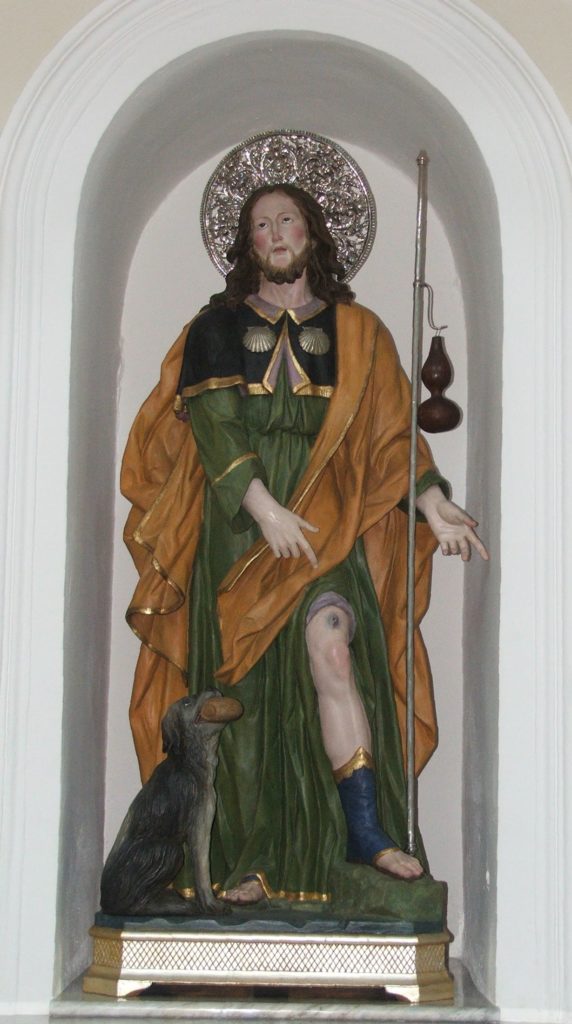
Il santo è rappresentato secondo l’iconografia classica rocchiana post cinquecentesca, cioè vestito da pellegrino, con il tabarro, un mantello a tutt’altezza, e un tabarrino, che è una mantellina di dimensioni ridotte, che proprio per la caratteristica di essere rappresentata addosso al Santo prese il nome di sanrocchino. Vicino al braccio sinistro è posto un lungo bastone con appesa una borraccia a forma di zucca e sul petto ha due conchiglie di capesanta, simboli del pellegrinaggio a Santiago di Compostela e della vita in cammino verso l’Eterno. Con la mano destra indica la lesione sulla gamba destra, provocata dal bubbone della peste che il Santo contrasse presso Piacenza.
È accompagnato da un piccolo cane, simbolo della fedeltà alla chiamata divina, che reca in bocca un pane, segno tangibile della Divina Provvidenza.
La cappella venne restaurata negli anni Trenta del Novecento a spese della signora Matilda Ferrara in Buonopane.
Il primo restauro noto venne realizzato verso la metà del Novecento, forse ad opera di Antonio Del Grosso. Tuttavia tra la fine dell’Ottocento e la prima metà del Novecento, subì un intervento che rese la scultura scomponibile per esigenze processionali.
Dopo il terremoto del 1980, la scultura subì un intervento di restauro di tipo estetico. L’ultimo intervento conservativo è stato effettuato nel 2018 dalla restauratrice Margherita Gramaglia che ha eliminato i rifacimenti impropri, ha consolidato l’intera struttura, ripristinando le forme e i colori originali della scultura.
The sculpture, as shown by the last restoration, is made up of several pieces of wood assembled with pins and animal glue, covered with a preparatory layer of canvas and plaster which serves as the basis for drawing and color.
The work was purchased by Domenico Abruzzese, in agreement with the archpriest Nicola Bianco, in conjunction with the cholera epidemics of the first half of the nineteenth century.
The saint is represented according to the post-sixteenth-century classical Rococo iconography, that is, dressed as a pilgrim, with the tabarro, a full-height cloak, and a tabarrino, which is a cape of small size, which precisely because of the characteristic of being represented on to the Saint it took the name of Sanrocchino. Near the left arm there is a long stick with a pumpkin-shaped water bottle hanging on it and on its chest it has two scallop shells, symbols of the pilgrimage to Santiago de Compostela and life on the way to the Eternal. With his right hand he indicates the lesion on the right leg, caused by the plague bubbone that the Saint contracted near Piacenza. He is accompanied by a small dog, a symbol of fidelity to the divine call, who bears bread in his mouth, a tangible sign of Divine Providence.
The chapel was restored in the 1930s at the expense of Mrs. Matilda Ferrara in Buonopane.
The first known restoration was carried out in the mid-twentieth century, perhaps by Antonio Del Grosso. However, between the end of the nineteenth century and the first half of the twentieth century, it underwent an intervention that made the sculpture decomposable for processional needs. After the 1980 earthquake, the sculpture underwent an aesthetic restoration. The last conservative intervention was carried out in 2018 by the restorer Margherita Gramaglia who eliminated the improper renovations, consolidated the entire structure, restoring the original shapes and colors of the sculpture.

Chiesa di S. Maria Maggiore
Scultura
San Rocco
Sec. XVIII (fine)
Legno scolpito/ dipinto
Ambito culturale napoletano

Church of S. Maria Maggiore
Sculpture
San Rocco
18th century (end)
Carved / painted wood
Neapolitan cultural sphere
La scultura, come risulta dall’ultimo restauro, è composta da più pezzi di legno assemblati con perni e con colla animale, ricoperti da uno strato preparatorio di tela e gesso che serve da base per il disegno ed il colore.
L’opera venne acquistata da Domenico Abruzzese, in accordo con l’arciprete Nicola Bianco, in concomitanza con le epidemie di colera della prima metà dell’Ottocento.
Il santo è rappresentato secondo l’iconografia classica rocchiana post cinquecentesca, cioè vestito da pellegrino, con il tabarro, un mantello a tutt’altezza, e un tabarrino, che è una mantellina di dimensioni ridotte, che proprio per la caratteristica di essere rappresentata addosso al Santo prese il nome di sanrocchino. Vicino al braccio sinistro è posto un lungo bastone con appesa una borraccia a forma di zucca e sul petto ha due conchiglie di capesanta, simboli del pellegrinaggio a Santiago di Compostela e della vita in cammino verso l’Eterno. Con la mano destra indica la lesione sulla gamba destra, provocata dal bubbone della peste che il Santo contrasse presso Piacenza.
È accompagnato da un piccolo cane, simbolo della fedeltà alla chiamata divina, che reca in bocca un pane, segno tangibile della Divina Provvidenza.
La cappella venne restaurata negli anni Trenta del Novecento a spese della signora Matilda Ferrara in Buonopane.
Il primo restauro noto venne realizzato verso la metà del Novecento, forse ad opera di Antonio Del Grosso. Tuttavia tra la fine dell’Ottocento e la prima metà del Novecento, subì un intervento che rese la scultura scomponibile per esigenze processionali.
Dopo il terremoto del 1980, la scultura subì un intervento di restauro di tipo estetico. L’ultimo intervento conservativo è stato effettuato nel 2018 dalla restauratrice Margherita Gramaglia che ha eliminato i rifacimenti impropri, ha consolidato l’intera struttura, ripristinando le forme e i colori originali della scultura.
The sculpture, as shown by the last restoration, is made up of several pieces of wood assembled with pins and animal glue, covered with a preparatory layer of canvas and plaster which serves as the basis for drawing and color.
The work was purchased by Domenico Abruzzese, in agreement with the archpriest Nicola Bianco, in conjunction with the cholera epidemics of the first half of the nineteenth century.
The saint is represented according to the post-sixteenth-century classical Rococo iconography, that is, dressed as a pilgrim, with the tabarro, a full-height cloak, and a tabarrino, which is a cape of small size, which precisely because of the characteristic of being represented on to the Saint it took the name of Sanrocchino. Near the left arm there is a long stick with a pumpkin-shaped water bottle hanging on it and on its chest it has two scallop shells, symbols of the pilgrimage to Santiago de Compostela and life on the way to the Eternal. With his right hand he indicates the lesion on the right leg, caused by the plague bubbone that the Saint contracted near Piacenza. He is accompanied by a small dog, a symbol of fidelity to the divine call, who bears bread in his mouth, a tangible sign of Divine Providence.
The chapel was restored in the 1930s at the expense of Mrs. Matilda Ferrara in Buonopane.
The first known restoration was carried out in the mid-twentieth century, perhaps by Antonio Del Grosso. However, between the end of the nineteenth century and the first half of the twentieth century, it underwent an intervention that made the sculpture decomposable for processional needs. After the 1980 earthquake, the sculpture underwent an aesthetic restoration. The last conservative intervention was carried out in 2018 by the restorer Margherita Gramaglia who eliminated the improper renovations, consolidated the entire structure, restoring the original shapes and colors of the sculpture.

Chiesa di S. Maria Maggiore
Busto reliquario
San Tommaso d’Aquino
Sec. XVII (prima metà)
Ottone e argento sbalzato/cesellato/ fuso
Ambito culturale napoletano

Church of S. Maria Maggiore
Reliquary bust
Saint Thomas Aquinas
17th century (first half)
Embossed/ chiseled/ cast brass and silver.
Neapolitan cultural sphere
Il busto di San Tommaso d’Aquino, in metallo prezioso, è l’immagine più antica del Santo conservata nella comunità grottese .
Il manufatto artistico è documentato per la prima volta in un inventario composto tra l’ottobre e il novembre 1659 dall’arciprete Giovanni Grasso di Ariano Irpino: «Una statua di San Tommaso d’Aquino, che si conserva nella stanza che si dice lo studio di San Tommaso: la testa e mani d’argento, il giglio d’argento, l’ostiario tiene nelle [mani] d’ottone indorato et argento, lo libro, diadema».
La tipologia del manufatto rimanda ai busti d’argento dei santi patroni di Napoli, conservati nella Cappella del Tesoro del Duomo della città partenopea e ai busti reliquiari di Montevergine. Nello specifico, il busto di Grottaminarda è assimilabile al busto del San Tommaso, realizzato nel 1628 da Francesco Buccamando per volere di Carlo d’Aquino, per la Chiesa di San Domenico Maggiore di Napoli, scomparso in età napoleonica, ma di cui si conserva il bozzetto in creta a Lamezia Terme.
Il busto venne probabilmente realizzato in epoca compresa tra il 1631, l’anno dell’eruzione del Vesuvio, e il 1656, l’anno della peste.
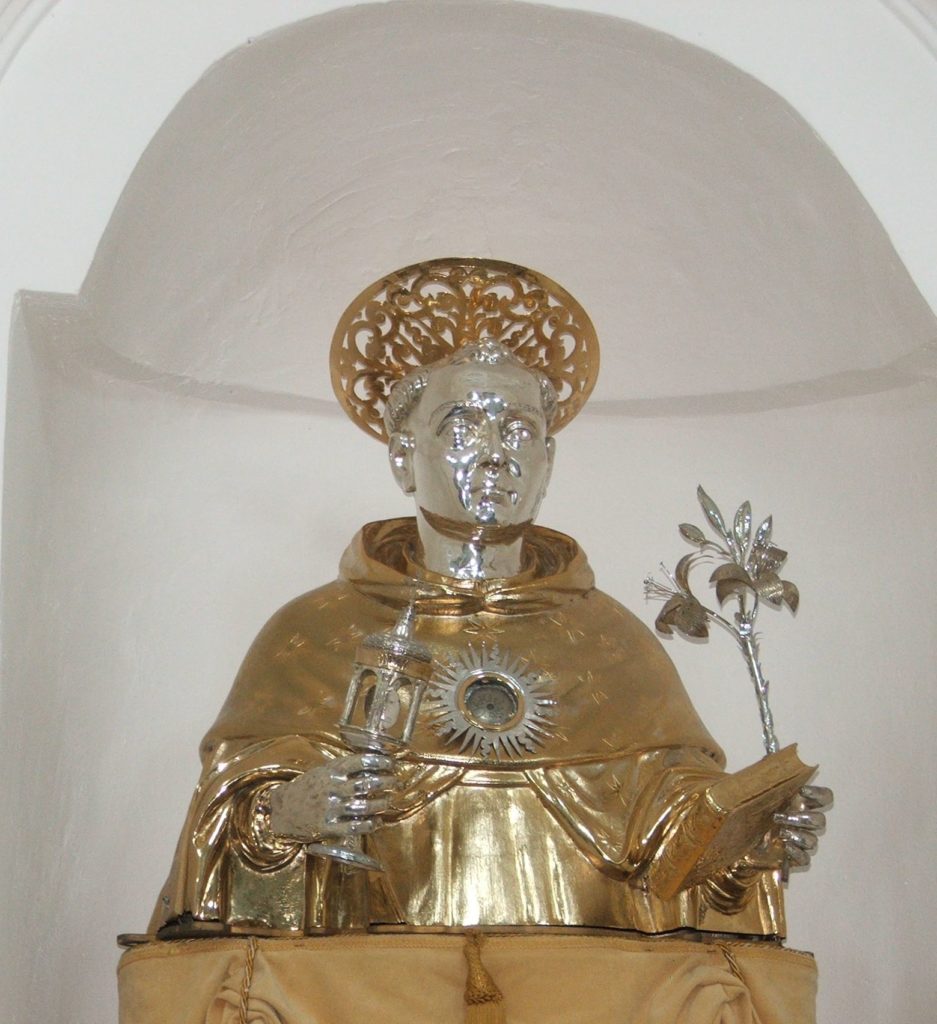
San Tommaso d’Aquino è rappresentato nelle sue vesti di frate domenicano, il mantello e la mozzetta ricoperte di stelle. Nella mano destra regge un ostensorio architettonico, mentre nella sinistra un giglio. La testa, le mani e il giglio sono d’argento lavorato a fusione, mentre le altre parti sono di ottone indorato.
Nel petto, in un medaglione a forma di sole raggiato, è conservata la reliquia del braccio del Santo.
Il busto venne realizzato per essere esposto nella Chiesa di S. Maria Maggiore di Grottaminarda, ma in un epoca imprecisata, forse dopo il terremoto del 1732, venne trasferito presso la Chiesa di San Tommaso d’Aquino.
Da alcuni anni il busto è ritornato nella Chiesa di S. Maria Maggiore.
The bust of St. Thomas Aquinas, in precious metal, is the oldest image of the saint preserved in the Grottese community.
The artistic artefact is documented for the first time in an inventory composed between October and November 1659 by the archpriest of Ariano Irpino Giovanni Grasso: «A sculpture of San Tommaso d’Aquino, which is kept in the room called the study of St. Thomas: the head and hands of silver, the silver lily, the hospice holds in the …. gilded and silver brass, the book, diadem».
The typology of the artifact refers to the silver busts of the patron saints of Naples, preserved in the Treasure Chapel of the Cathedral of the Neapolitan city and to the reliquary busts of Montevergine. Specifically, the bust of Grottaminarda is similar to the bust of San Tommaso, made in 1628 by Francesco Buccamando for want of Carlo d’Aquino, for the Church of San Domenico Maggiore in Naples, who disappeared in the Napoleonic era, but of which the clay sketch is preserved in Lamezia Terme.
The bust was probably made in the period between 1631, the year of the eruption of Vesuvius, and 1656, the year of the plague.
St. Thomas Aquinas is represented in his Dominican friar robes, his cloak and mozzetta covered with stars. In his right hand he holds an architectural monstrance, while in his left a lily. The head, hands and lily are in fusion silver, while the other parts are in golden brass.
In the chest, in a radiant sun shape medallion, the relic of the arm of the Saint is kept.
The bust was made to be displayed in the Church of S. Maria Maggiore in Grottaminarda, but in an unspecified period, perhaps after the 1732 earthquake, it was transferred to the Church of San Tommaso d’Aquino.
For some years the bust has returned to the Church of S. Maria Maggiore.

Chiesa di S. Maria Maggiore
Scultura
Sant’Antonio di Padova
Sec. XVIII (seconda metà)
Legno scolpito e dipinto
Ambito culturale napoletano
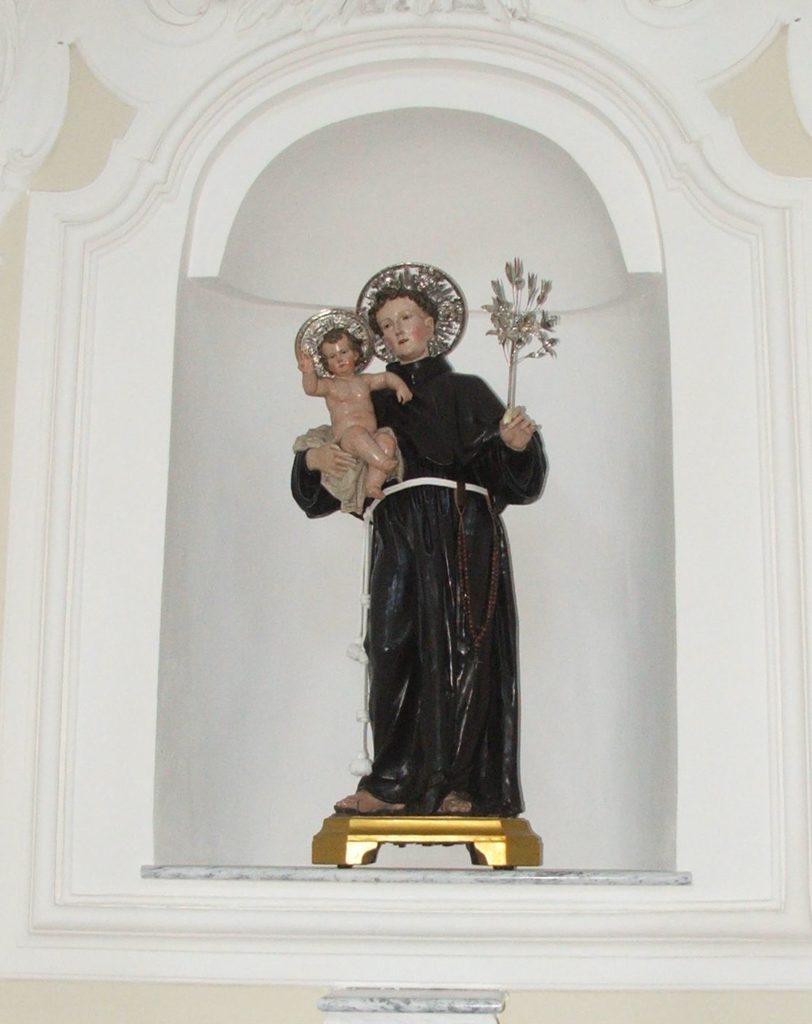
La scultura lignea di Sant’Antonio da Padova, si presenta secondo la consueta iconografia antoniana, nota fin dalla fine del XV secolo, ovvero quella di un frate francescano in piedi, molto giovane, con il bambino Gesù in braccio e il giglio in mano.
La scultura, come è emerso nel corso del restauro del 2007, è composta da pezzi di legno di salice e pioppo assemblati con perni e colla animale.
Il manufatto venne acquistato durante la seconda metà del XIX secolo dalla Confraternita di San Tommaso d’Aquino per decorare l’altare di Sant’Antonio da Padova nella Chiesa di San Tommaso d’Aquino.
Il detto altare, nel giugno 1886, venne elevato ad altare privilegiato con l’indulgenza plenaria per le anime del Purgatorio, da Papa Leone XIII.
Il primo restauro noto della scultura, ascrivibile all’ambito culturale napoletano, risale al 1994. Un secondo restauro, che riportò la statua all’aspetto originario, venne effettuato nel 2007. In particolare, con questo restauro vennero eliminati gli strati sovrapposti nel tempo di colore e gesso, venne consolidata l’intera struttura e vennero reintegrate le forme ed i colori originali. Un ulteriore intervento di disinfestazione dagli insetti xilofagi venne effettuato nel 2014 a cura del restauratore Luigi La Bella.
Sempre nello stesso anno, al fine di prevenire ulteriori attacchi di insetti xilofagi, salvaguardare il manufatto e favorire il culto del Santo, la scultura venne trasferita nella Chiesa di S. Maria Maggiore.
The wooden sculpture of Saint Anthony of Padua is presented according to the usual Antonian iconography, known since the end of the fifteenth century, or that of a Franciscan friar standing, very young, with the baby Jesus in his arms and the lily in his hand.
The sculpture, as it emerged during the 2007 restoration, is composed of pieces of willow and poplar wood assembled with pins and animal glue.
The artifact was purchased during the second half of the nineteenth century by the Confraternity of St. Thomas Aquinas to decorate the altar of St. Anthony of Padua in the Church of St. Thomas Aquinas.
The said altar, in June 1886, was elevated to a privileged altar with plenary indulgence for the souls of Purgatory, by Pope Leo XIII.
The first known restoration of the sculpture, attributable to the Neapolitan cultural environment, dates back to 1994. A second restoration, which brought the statue back to its original appearance, was carried out in 2007. In particular, with this restoration the overlapping layers were eliminated in the time of color and plaster, the entire structure was consolidated and the original shapes and colors were reinstated. A further disinfection intervention by xylophagous insects was carried out in 2014 by the restorer Luigi La Bella.
Also in the same year, in order to prevent further attacks of xylophagous insects, safeguard the artifact and favor the cult of the Saint, the sculpture was transferred to the Church of S. Maria Maggiore.

Church of S. Maria Maggiore
Sculpture
Saint Anthony of Padua
18th century (second half)
Carved and painted wood
Neapolitan cultural sphere
La scultura lignea di Sant’Antonio da Padova, si presenta secondo la consueta iconografia antoniana, nota fin dalla fine del XV secolo, ovvero quella di un frate francescano in piedi, molto giovane, con il bambino Gesù in braccio e il giglio in mano.
La scultura, come è emerso nel corso del restauro del 2007, è composta da pezzi di legno di salice e pioppo assemblati con perni e colla animale.
Il manufatto venne acquistato durante la seconda metà del XIX secolo dalla Confraternita di San Tommaso d’Aquino per decorare l’altare di Sant’Antonio da Padova nella Chiesa di San Tommaso d’Aquino.
Il detto altare, nel giugno 1886, venne elevato ad altare privilegiato con l’indulgenza plenaria per le anime del Purgatorio, da Papa Leone XIII.
Il primo restauro noto della scultura, ascrivibile all’ambito culturale napoletano, risale al 1994. Un secondo restauro, che riportò la statua all’aspetto originario, venne effettuato nel 2007. In particolare, con questo restauro vennero eliminati gli strati sovrapposti nel tempo di colore e gesso, venne consolidata l’intera struttura e vennero reintegrate le forme ed i colori originali. Un ulteriore intervento di disinfestazione dagli insetti xilofagi venne effettuato nel 2014 a cura del restauratore Luigi La Bella.
Sempre nello stesso anno, al fine di prevenire ulteriori attacchi di insetti xilofagi, salvaguardare il manufatto e favorire il culto del Santo, la scultura venne trasferita nella Chiesa di S. Maria Maggiore.
The wooden sculpture of Saint Anthony of Padua is presented according to the usual Antonian iconography, known since the end of the fifteenth century, or that of a Franciscan friar standing, very young, with the baby Jesus in his arms and the lily in his hand.
The sculpture, as it emerged during the 2007 restoration, is composed of pieces of willow and poplar wood assembled with pins and animal glue.
The artifact was purchased during the second half of the nineteenth century by the Confraternity of St. Thomas Aquinas to decorate the altar of St. Anthony of Padua in the Church of St. Thomas Aquinas.
The said altar, in June 1886, was elevated to a privileged altar with plenary indulgence for the souls of Purgatory, by Pope Leo XIII.
The first known restoration of the sculpture, attributable to the Neapolitan cultural environment, dates back to 1994. A second restoration, which brought the statue back to its original appearance, was carried out in 2007. In particular, with this restoration the overlapping layers were eliminated in the time of color and plaster, the entire structure was consolidated and the original shapes and colors were reinstated. A further disinfection intervention by xylophagous insects was carried out in 2014 by the restorer Luigi La Bella.
Also in the same year, in order to prevent further attacks of xylophagous insects, safeguard the artifact and favor the cult of the Saint, the sculpture was transferred to the Church of S. Maria Maggiore.

Chiesa di S. Maria Maggiore
Scultura
La Pietà
Sec. XVI (prima metà)
Legno scolpito e dipinto
Ambito culturale napoletano

Church of S. Maria Maggiore
Sculpture
The Pity
16th century (first half)
Carved and painted wood
Neapolitan cultural sphere
Secondo la tradizione, non suffragata da documenti, l’opera sarebbe stata commissionata per la Chiesa di San Tommaso d’Aquino da Ladislao II d’Aquino, Marchese di Corato e Barone di Grottaminarda, vissuto tra la fine del XV secolo e la prima metà del XVI secolo. Nel primo documento noto, del 1698, che attesta la presenza dell’opera a Grottaminarda, risulta che la statua faceva parte di un gruppo scultoreo che comprendeva anche le statue di San Tommaso e di San Giacomo. Il gruppo di deposizione venne disperso tra la fine dell’Ottocento e l’inizio del Novecento.
According to tradition, not supported by documents, the work was commissioned for the Church of San Tommaso d’Aquino by Ladislao II d’Aquino, Marquis of Corato and Baron of Grottaminarda, who lived between the end of the fifteenth century and the first half of 16th century. In the first known document, from 1698, which attests to the presence of the work in Grottaminarda, it appears that the statue was part of a sculptural group that also included the statues of San Tommaso and San Giacomo. The deposition group was dispersed between the late nineteenth and early twentieth centuries.
Originariamente l’opera non fu concepita come statua per processione, ma dopo un restauro avvenuto nel XVII secolo, fu riadattata come statua processionale. Si tramanda che la statua veniva impiegata durante i riti della settimana Santa, principalmente durante la pia pratica delle “tre ore di agonia” del Venerdì Santo.
La scultura, per cifra stilistica, va datata alla prima metà del XVI secolo. L’ultimo restauro ha evidenziato un precedente e importante intervento ascrivibile alla prima metà del XVII secolo, che può essere messo in relazione alla ricostruzione della Chiesa di San Tommaso d’Aquino del 1636.
L’opera, come ha dimostrato l’ultimo restauro, era stata scolpita in un solo pezzo di legno di pioppo, o meglio da due alberi di pioppo che nel corso della loro vita si erano fusi insieme formando un unico albero ma con un doppio midollo.
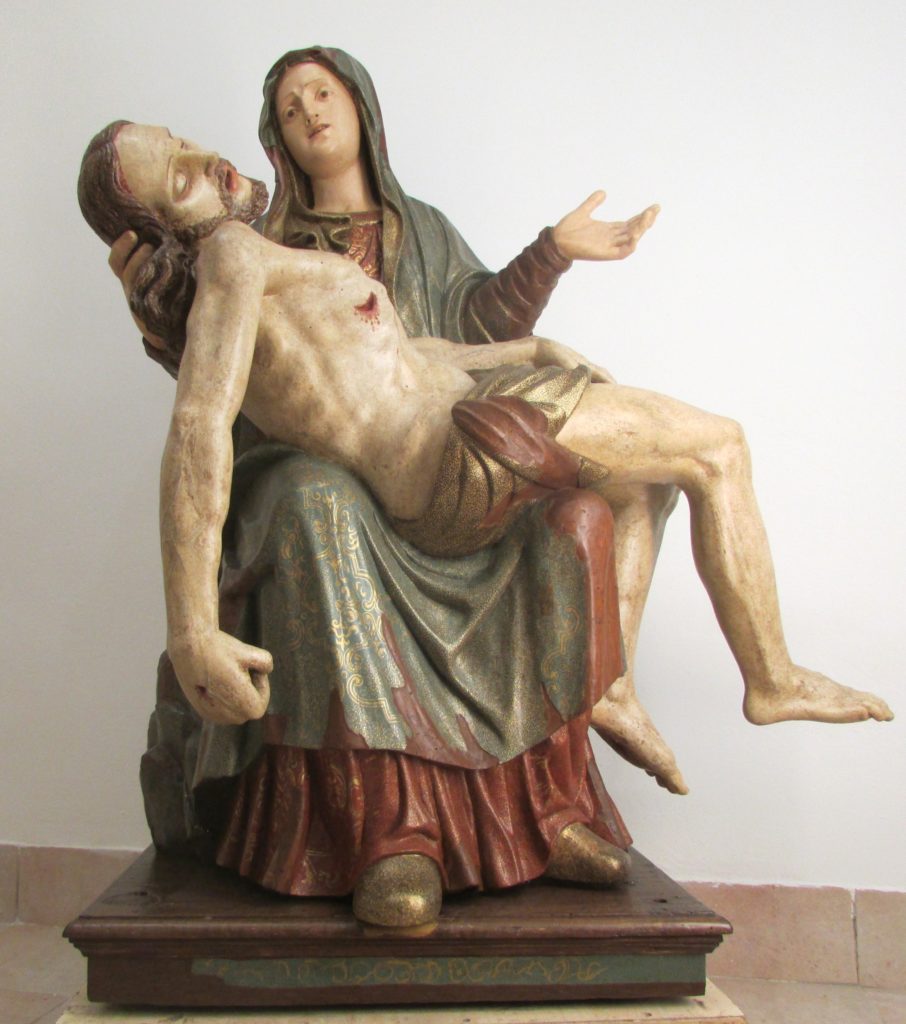
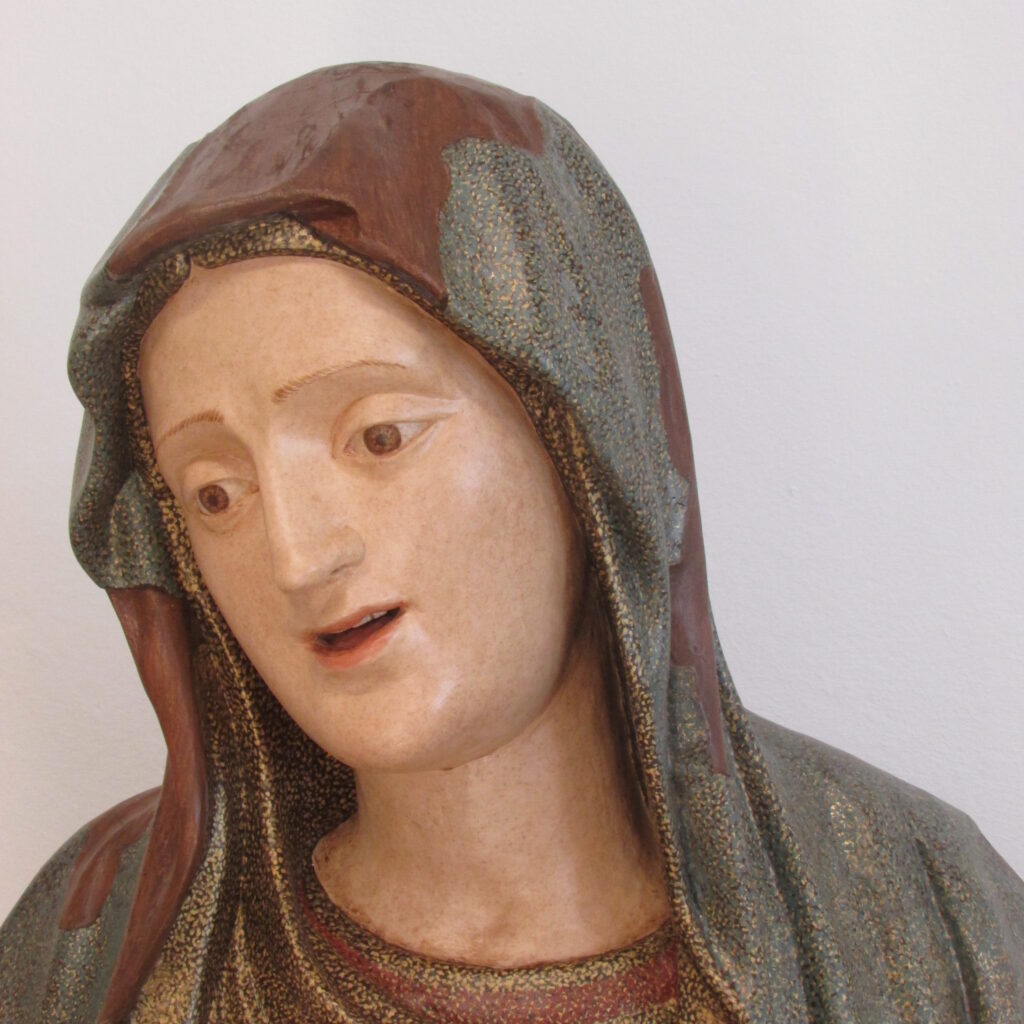
L’anonimo artista della Pietà grottese conosceva le innovazioni artistiche introdotte da Michelangelo nella scultura, anche se l’impostazione è ancora legata alla cultura tardogotica e cortese meridionale. La Madonna raffigurata giovane con lo sguardo pacato e rassegnato, il riccio di stoffa sul petto, la mano sinistra aperta e rivolta verso l’alto, l’abbandono del corpo e la perfezione anatomica del Cristo, sono chiari riferimenti alle Pietà eseguite da Michelangelo; mentre la rigidità di Maria e del busto del Cristo sono invece il segno, ancora forte ed evidente, della cultura tardogotica e cortese.
La scultura è stata restaurata più volte nel corso dei secoli: una prima volta nel XVII secolo, poi ha subito vari interventi tra il XVIII secolo e il XX secolo. L’ultimo lavoro di restauro risale agli anni 2017-2018 ed è stato operato da Luigi La Bella, di Bologna, che ha riportato l’opera agli antichi
splendori.
Originally the work was not conceived as a procession statue, but after a restoration that took place in the seventeenth century, it was adapted as a processional statue. It is said that the statue was used during the Holy Week rites, mainly during the pious practice of the “three hours of agony” on Good Friday.
The sculpture, for stylistic figure, goes dated to the first half of the XVI century. The latest restoration has highlighted a previous and important intervention attributable to the first half of the seventeenth century, which can be related to the reconstruction of the Church of San Tommaso d’Aquino in 1636.
The work, as demonstrated by the last restoration, had been carved in a single piece of poplar wood, or rather by two poplar trees that in the course of their life had merged together forming a single tree but with a double marrow.
The anonymous artist of the Grottese Pity knew the artistic innovations introduced by Michelangelo in sculpture, even if the setting is still linked to the late Gothic and courtly southern culture. The Madonna depicted young with a calm and resigned gaze, the hedgehog on the breast, the left hand open and facing upwards, the abandonment of the body and the anatomical perfection of Christ, are clear references to the Pietà performed by Michelangelo; while the rigidity of Mary and the bust of Christ are instead the sign, still strong and evident, of the late Gothic and courteous culture.
The sculpture has been restored several times over the centuries: a first time in the 17th century, then it underwent various interventions between the 18th century and the 20th century. The last restoration work dates back to the years 2017-2018 and was carried out by Luigi La Bella, from Bologna, who restored the work to its former glory.
Church of S. Maria Maggiore
Bust
Saint Joseph with Child
18th century (second half)
Carved and painted wood
Neapolitan cultural sphere
Il culto di San Giuseppe, sposo di Maria, è documentato a Grottaminarda sin dal 1453 come documenta un beneficio parrocchiale della Chiesa di San Michele
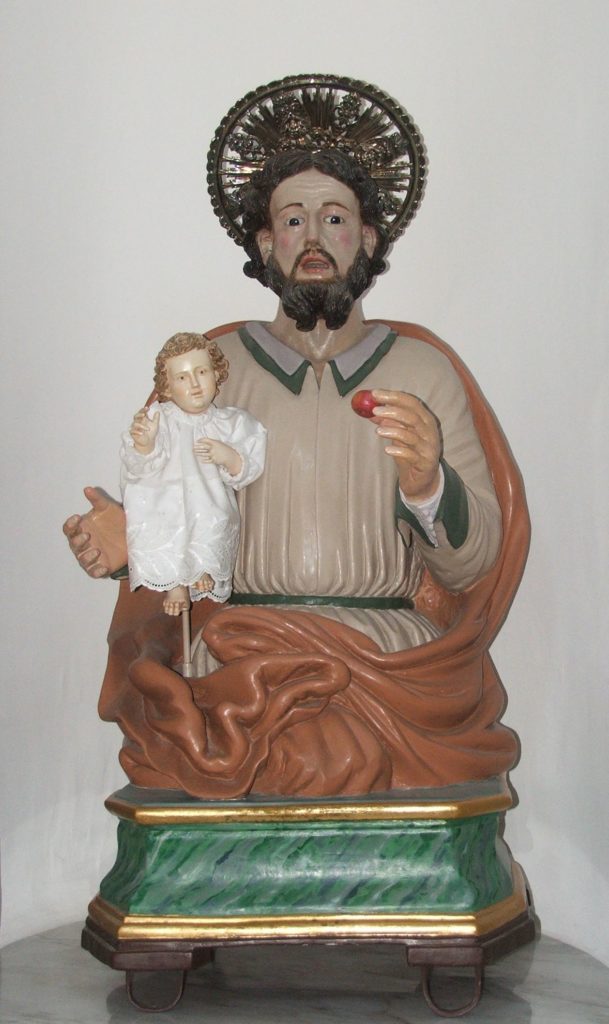
La scultura, realizzata nel corso del Settecento, raffigura San Giuseppe a mezzo busto con il Bambino in braccio. La figura del Bambino non è originale ma è stata aggiunta, nel corso degli anni ‘90 del Novecento, dopo il trafugamento di quella originale. San Giuseppe è raffigurato con lo sguardo stupito e una mela in mano, secondo un’iconografica di origine nordica piuttosto rara. Questa iconografia proviene dai racconti sulla Fuga in Egitto dove San Giuseppe raccoglie della frutta, una mela o un cesto di ciliegie, e li porge a Maria.
Col passare del tempo, l’immagine muta e la mela diventa attributo iconografico del Bambino, rappresentato nell’atto di porgerla a Giuseppe.
Dal primitivo simbolismo, legato all’incarnazione di Gesù, l’immagine passa ad indicare la missione propria di Cristo. La mela è tradizionalmente il frutto dell’Albero della Vita e così Gesù è la “nuova vita” che si offre a Giuseppe e al mondo; è anche il simbolo del peccato, di cui Gesù si fa carico.
The cult of St. Joseph, Mary’s husband, has been documented in Grottaminarda since 1453 as a parochial benefit of the Church of San Michele documents.
The sculpture, made during the eighteenth century, depicts Saint Joseph half-length with the Child in his arms. The figure of the Child is not original but was added, during the 90s of the twentieth century, after the stealing of the original one.
St. Joseph is depicted with an astonished gaze and an apple in his hand, according to a rather rare iconography of Nordic origin. This iconography comes from the stories about the Flight into Egypt where St. Joseph collects fruit, an apple or a basket of cherries, and hands them to Mary.
Over the time the image has changed and the apple has become an iconographic attribute of the Child, represented in the act of offering it to Giuseppe.
From the primitive symbolism, linked to the incarnation of Jesus, the image goes to indicate the mission proper to Christ. The apple is traditionally the fruit of the Tree of Life and thus Jesus is the “new life” that is offered to Joseph and the world; it is also the symbol of sin, which Jesus takes on.

Chiesa di S. Maria Maggiore
Busto
San Giuseppe con Bambino
Sec. XVIII (seconda metà)
Legno scolpito e dipinto
Ambito culturale napoletano

Church of S. Maria Maggiore
Bust
Saint Joseph with Child
18th century (second half)
Carved and painted wood
Neapolitan cultural sphere
Il culto di San Giuseppe, sposo di Maria, è documentato a Grottaminarda sin dal 1453 come documenta un beneficio parrocchiale della Chiesa di San Michele
La scultura, realizzata nel corso del Settecento, raffigura San Giuseppe a mezzo busto con il Bambino in braccio. La figura del Bambino non è originale ma è stata aggiunta, nel corso degli anni ‘90 del Novecento, dopo il trafugamento di quella originale. San Giuseppe è raffigurato con lo sguardo stupito e una mela in mano, secondo un’iconografica di origine nordica piuttosto rara. Questa iconografia proviene dai racconti sulla Fuga in Egitto dove San Giuseppe raccoglie della frutta, una mela o un cesto di ciliegie, e li porge a Maria.
Col passare del tempo, l’immagine muta e la mela diventa attributo iconografico del Bambino, rappresentato nell’atto di porgerla a Giuseppe.
Dal primitivo simbolismo, legato all’incarnazione di Gesù, l’immagine passa ad indicare la missione propria di Cristo. La mela è tradizionalmente il frutto dell’Albero della Vita e così Gesù è la “nuova vita” che si offre a Giuseppe e al mondo; è anche il simbolo del peccato, di cui Gesù si fa carico.
The cult of St. Joseph, Mary’s husband, has been documented in Grottaminarda since 1453 as a parochial benefit of the Church of San Michele documents.
The sculpture, made during the eighteenth century, depicts Saint Joseph half-length with the Child in his arms. The figure of the Child is not original but was added, during the 90s of the twentieth century, after the stealing of the original one.
St. Joseph is depicted with an astonished gaze and an apple in his hand, according to a rather rare iconography of Nordic origin. This iconography comes from the stories about the Flight into Egypt where St. Joseph collects fruit, an apple or a basket of cherries, and hands them to Mary.
Over the time the image has changed and the apple has become an iconographic attribute of the Child, represented in the act of offering it to Giuseppe.
From the primitive symbolism, linked to the incarnation of Jesus, the image goes to indicate the mission proper to Christ. The apple is traditionally the fruit of the Tree of Life and thus Jesus is the “new life” that is offered to Joseph and the world; it is also the symbol of sin, which Jesus takes on.

Chiesa di S. Maria Maggiore
Scultura
San Francesco d’Assisi
Sec. XVIII (prima metà)
legno scolpito e dipinto
Ambito culturale napoletano
Le prime notizie di un altare dedicato a San Francesco d’Assisi nella Chiesa Madre di Grottaminarda risalgono al XVII secolo, ma è noto che già la famiglia d’Aquino era legata all’ordine francescano. Infatti si ha notizia che Luca d’Aquino, signore di Grottaminarda dal 1289 al 1299, fu munifico benefattore dei frati minori di Benevento e alla sua morte fu seppellito nella Chiesa di San Francesco dei frati minori della città sannita.
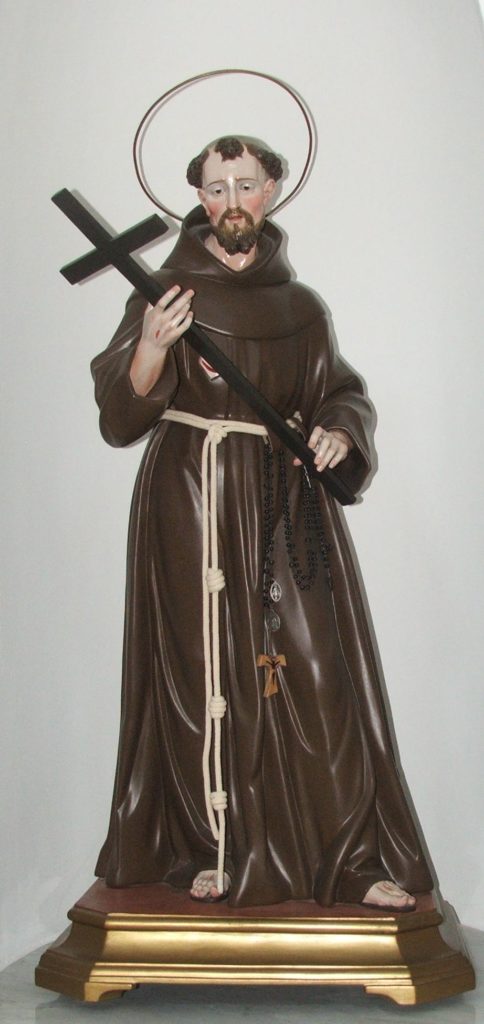
L’opera, realizzata in più pezzi di legno assemblati con perni e colla animale, rappresenta San Francesco nell’atto di contemplare il crocifisso tenuto tra le mani. Il viso e le mani del santo, fortemente connotati nell’anatomia, rimandano alla cultura artistica napoletana di primo Settecento.
La scultura è stata restaurata da Luigi Di Bella nel 2015.

Church of S. Maria Maggiore
Sculpture
Saint Francis of Assisi
18th century (first half)
carved and painted wood
Neapolitan cultural sphere
The first news of an altar dedicated to St. Francis of Assisi in the Mother Church of Grottaminarda date back to the 17th century, but it is known that the Aquino family was already linked to the Franciscan order. In fact, it is known that Luca d’Aquino, lord of Grottaminarda from 1289 to 1299, was a munificent benefactor of the Minor Friars of Benevento and was buried in the Church of San Francesco of the Minor Friars in the Samnite city.
The work, made of several pieces of wood assembled with pins and animal glue, represents Saint Francis in the act of contemplating the crucifix held in his hands. The face and hands of the saint, strongly characterized in anatomy, refer to the Neapolitan artistic culture of the early eighteenth century.
The sculpture was restored by Luigi Di Bella in 2015.
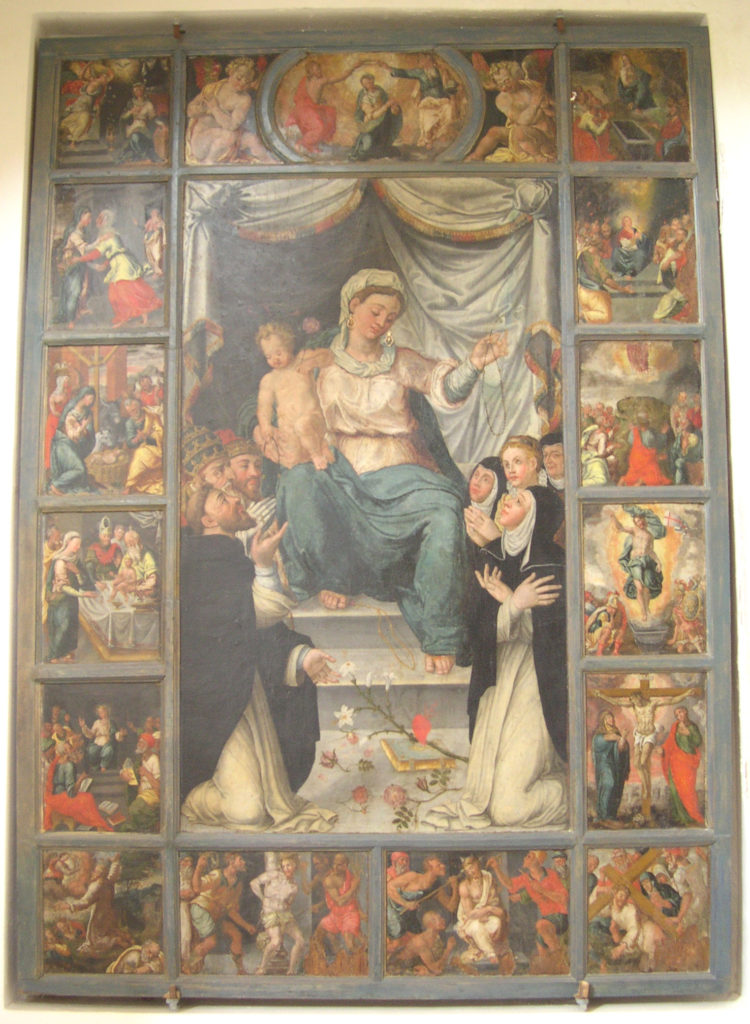
Partendo da sinistra e in senso antiorario individuiamo, sul lato sinistro: L’Annunciazione dell’Arcangelo Gabriele a Maria Vergine; La visita di Maria Vergine a Santa Elisabetta; La nascita di Gesù; La presentazione di Gesù al Tempio; Il ritrovamento di Gesù al Tempio. In basso: L’agonia di Gesù nell’orto degli ulivi; La flagellazione di Gesù alla colonna; L’incoronazione di spine; L’incontro tra Gesù e Maria sulla via del Calvario. Sul lato destro, risalendo: La crocifissione e la morte di Gesù; La Resurrezione di Gesù; L’Ascensione di Gesù al Cielo; La discesa dello Spirito Santo nel Cenacolo; L’Assunzione di Maria Vergine al Cielo. Al centro sopra il pannello centrale, tra due angeli in un ovale abbiamo: L’incoronazione di Maria Vergine.
The table was originally located in the Church of the Rosary, annexed to the Dominican convent founded in the mid-sixteenth century and closed due to lack of income in 1652.
At the beginning of the eighteenth century the table was transferred to the Mother Church and placed in the first chapel on the right. The work consists of a central panel depicting the Madonna and Child in the middle, San Domenico di Guzman, Pope Pius V and Philip II of Spain, positioned on the left; on the right you can recognize St. Catherine of Siena, a Dominican nun and two characters who could be the patrons. Between the two Dominican saints, at the foot of the platform on which the Madonna is seated, there are their iconographic attributes, the sacred book and the lily. Around the central figures, there are 15 panels depicting the mysteries of the Rosary.
Starting from the left and anticlockwise we identify, on the left side: The Annunciation of the Archangel Gabriel to the Virgin Mary; The visit of the Virgin Mary to Saint Elizabeth; The birth of Jesus; The Presentation of Jesus in the Temple; The finding of Jesus in the Temple. Below: The agony of Jesus in the garden of olives; The flagellation of Jesus on the column; The crowning with thorns; The meeting between Jesus and Mary on the way to Calvary. On the right side, going up: The crucifixion and death of Jesus; The Resurrection of Jesus; The Ascension of Jesus into Heaven; The descent of the Holy Spirit in the Upper Room; The Assumption of the Virgin Mary into Heaven. In the center above the central panel, between two angels in an oval we have: The coronation of the Virgin Mary.
L’opera, forse realizzata a Napoli tra la fine del XVI e i primi anni XVII secolo, risente delle influenze dell’arte fiamminga. Alcuni studiosi attribuiscono l’opera a Teodoro d’Errico
The work, perhaps made in Naples between the end of the 16th and the early 17th century, is influenced by the Flemish art and some scholars attribute it to Teodoro d’Errico.

Chiesa di S. Maria Maggiore
Pala d’altare
Hendricksz Dirk detto Teodoro d’Errico (cerchia)
Madonna del Rosario con San Domenico e Santa Caterina, santi e misteri del Rosario
Sec. XVI (fine) – sec. XVII (inizio)
Olio su tela

Church of S. Maria Maggiore
Altarpiece
Hendricksz Dirk called Teodoro d’Errico (circle)
Madonna of the Rosary with San Domenico and Santa Caterina, saints and mysteries of the rosary
XVI century (end) – XVII century (beginning)
Oil on the table
La tavola si trovava in origine nella Chiesa del Rosario, annessa al convento domenicano fondato verso la metà del XVI secolo e chiuso per mancanza di rendite nel 1652.
All’inizio del Settecento la tavola venne trasferita nella Chiesa Madre e posizionata nella prima cappella a destra. L’opera è composta da un pannello centrale raffigurante la Madonna con Bambino al centro, sulla sinistra San Domenico di Guzman, Papa Pio V e Filippo II di Spagna, posizionati a sinistra; sulla destra sono riconoscibili S. Caterina da Siena, una suora domenicana e due personaggi che potrebbero essere i committenti. Tra i due santi domenicani, ai piedi della pedana sulla quale è assisa la Madonna, sono presenti i loro attributi iconografici, il libro sacro ed il giglio. Intorno alle figure centrali, ci sono 15 riquadri raffiguranti i misteri del Rosario.
Partendo da sinistra e in senso antiorario individuiamo, sul lato sinistro: L’Annunciazione dell’Arcangelo Gabriele a Maria Vergine; La visita di Maria Vergine a Santa Elisabetta; La nascita di Gesù; La presentazione di Gesù al Tempio; Il ritrovamento di Gesù al Tempio. In basso: L’agonia di Gesù nell’orto degli ulivi; La flagellazione di Gesù alla colonna; L’incoronazione di spine; L’incontro tra Gesù e Maria sulla via del Calvario. Sul lato destro, risalendo: La crocifissione e la morte di Gesù; La Resurrezione di Gesù; L’Ascensione di Gesù al Cielo; La discesa dello Spirito Santo nel Cenacolo; L’Assunzione di Maria Vergine al Cielo. Al centro sopra il pannello centrale, tra due angeli in un ovale abbiamo: L’incoronazione di Maria Vergine.
The table was originally located in the Church of the Rosary, annexed to the Dominican convent founded in the mid-sixteenth century and closed due to lack of income in 1652.
At the beginning of the eighteenth century the table was transferred to the Mother Church and placed in the first chapel on the right. The work consists of a central panel depicting the Madonna and Child in the middle, San Domenico di Guzman, Pope Pius V and Philip II of Spain, positioned on the left; on the right you can recognize St. Catherine of Siena, a Dominican nun and two characters who could be the patrons. Between the two Dominican saints, at the foot of the platform on which the Madonna is seated, there are their iconographic attributes, the sacred book and the lily. Around the central figures, there are 15 panels depicting the mysteries of the Rosary.
Starting from the left and anticlockwise we identify, on the left side: The Annunciation of the Archangel Gabriel to the Virgin Mary; The visit of the Virgin Mary to Saint Elizabeth; The birth of Jesus; The Presentation of Jesus in the Temple; The finding of Jesus in the Temple. Below: The agony of Jesus in the garden of olives; The flagellation of Jesus on the column; The crowning with thorns; The meeting between Jesus and Mary on the way to Calvary. On the right side, going up: The crucifixion and death of Jesus; The Resurrection of Jesus; The Ascension of Jesus into Heaven; The descent of the Holy Spirit in the Upper Room; The Assumption of the Virgin Mary into Heaven. In the center above the central panel, between two angels in an oval we have: The coronation of the Virgin Mary.
L’opera, forse realizzata a Napoli tra la fine del XVI e i primi anni XVII secolo, risente delle influenze dell’arte fiamminga. Alcuni studiosi attribuiscono l’opera a Teodoro d’Errico
The work, perhaps made in Naples between the end of the 16th and the early 17th century, is influenced by the Flemish art and some scholars attribute it to Teodoro d’Errico.

Chiesa di S. Maria Maggiore
Edificio sacro
Ciriaco Di Silvia, Domenico Quarata e altri
Chiesa di Santa Maria Maggiore
Sec. XVIII

Church of S. Maria Maggiore
Sacred building
Ciriaco Di Silvia, Domenico Quarata and others
Church of Santa Maria Maggiore
XVIII century
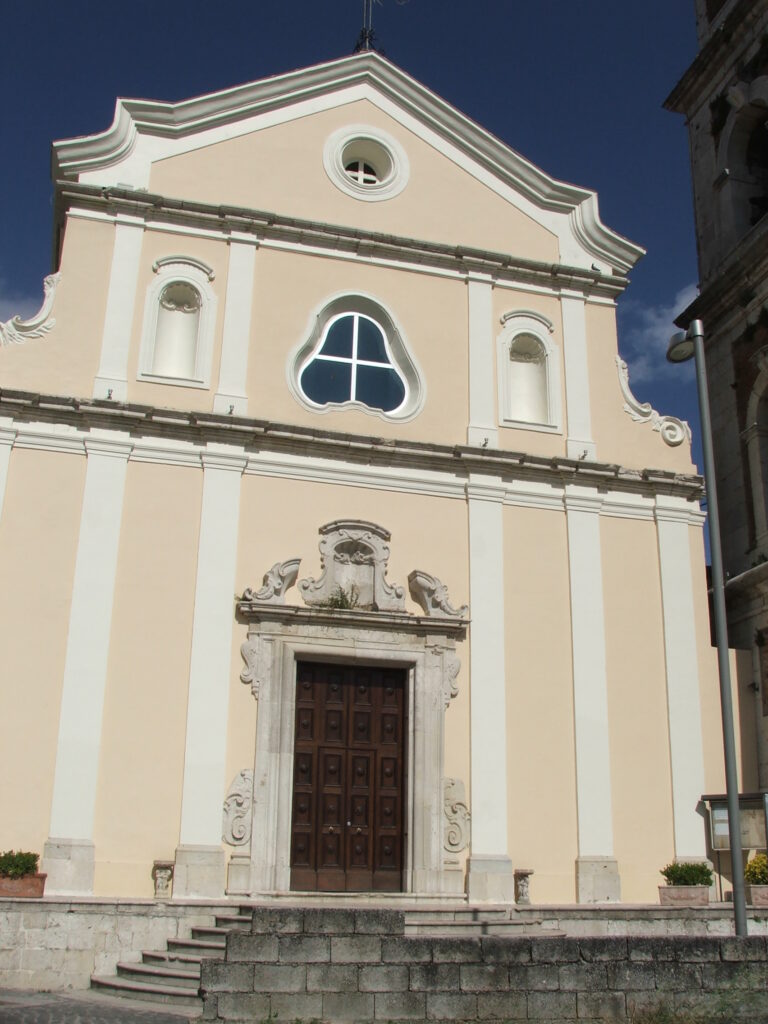
La Chiesa di Santa Maria Maggiore di Grottaminarda si impianta sul punto più alto della collina dove sorge il nucleo più antico dell’abitato grottese.
È la sede della Parrocchia di Santa Maria Maggiore e, dal 1478 al 1866, ebbe la qualifica di Chiesa Collegiale, con un capitolo di dodici cariche, tra cui l’arciprete, il primicerio maggiore, il primicerio minore e nove canonici.
La chiesa, oggi ufficialmente identificata come Chiesa di Santa Maria Maggiore, era nota nei documenti anche con il titolo di S. Maria Assunta in Cielo.
L’edificio è documentato con certezza soltanto verso la metà del XV secolo, ma, verosimilmente, si può ipotizzare che la struttura già esistesse alla fine del secolo precedente.
Nel 1447, su iniziativa di Ladislao I d’Aquino, signore di Grottaminarda, divenne la sede della nuova parrocchia di Santa Maria Maggiore, che a sua volta, dal 1453, divenne di patronato della stessa famiglia d’Aquino.
Distrutta dal terremoto del 5 dicembre 1456, la chiesa, ricostruita a spese dello stesso d’Aquino, venne solennemente consacrata e riaperta nel 1474.
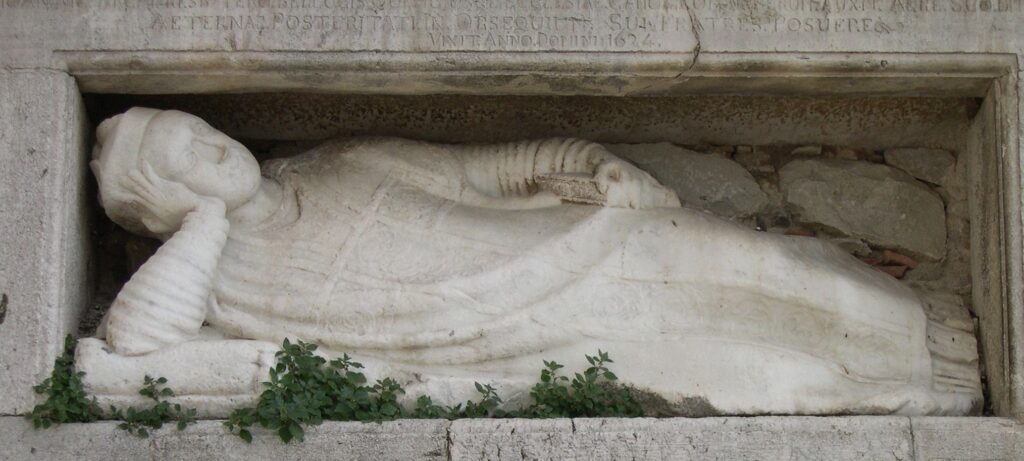
All’inizio del Seicento venne ristrutturata e abbellita a spese dell’arciprete Giovanni Nicola De Bellucis (1594-1627) che la fece riconsacrare nel 1621 e vi fece costruire il proprio monumento funebre nel 1625.
The Church of Santa Maria Maggiore in Grottaminarda stands on the highest point of the hill where the oldest part of the Grottese town stands.
It is the seat of the Parish of Santa Maria Maggiore and, from 1478 to 1866, it had the title of Collegial Church, with a chapter of twelve offices, including the archpriest, the major primicerius, the minor primicerius and nine canons.
The church, now officially identified as the Church of Santa Maria Maggiore, was also known in documents with the title of S. Maria Assunta in Cielo.
The building is documented with certainty only towards the middle of the 15th century, but, probably, it can be assumed that the structure already existed at the end of the previous century.
In 1447, on the initiative of Ladislao I d’Aquino, lord of Grottaminarda, it became the seat of the new parish of Santa Maria Maggiore, which in turn, from 1453, became the patronage of the Aquino family.
Destroyed by the earthquake of 5th December 1456, the church, rebuilt at the expense of Aquino himself, was solemnly consecrated and reopened in 1474.
At the beginning of the seventeenth century it was renovated and embellished at the expense of the archpriest Giovanni Nicola De Bellucis (1594-1627) who had it reconsecrated in 1621 and built his own funeral monument there in 1625.
A seguito del terremoto del 29 novembre 1732 la chiesa, per impulso dell’arciprete Pietro Antonio Perillo (1748—1796), venne ricostruita a spese della famiglia Coscia, nuovi feudatari di Grottaminarda, e solennemente consacrata nel 1774, nonostante i lavori non fossero stati ancora ultimati.
Following the earthquake of 29th November 1732, the church, at the instigation of the archpriest Pietro Antonio Perillo (1748-1796), was rebuilt at the expense of the Coscia family, new feudal lords of Grottaminarda, and solemnly consecrated in 1774, although the works had not been completed yet.
Subsequently the structure was damaged by various earthquakes: the first time from that of 23rd July 1930 and then restored by the initiative of the archpriest Alfonso Maria Cogliani (1925-1935); a second time from the earthquake of 21st August 1962 and then renovated and reopened for worship on 7 August 1966, under the pressure of the archpriest Giuseppe Pasquariello (1935-1970); one last time from the earthquake of 23rd November 1980 and, on the initiative of the parish priest Don Rocco Salierno (1983-1998), restored and reopened on 7th August 1993.
Further renovations were carried out between 2011 and 2016 by the parish priest Don Carmine Santoro.
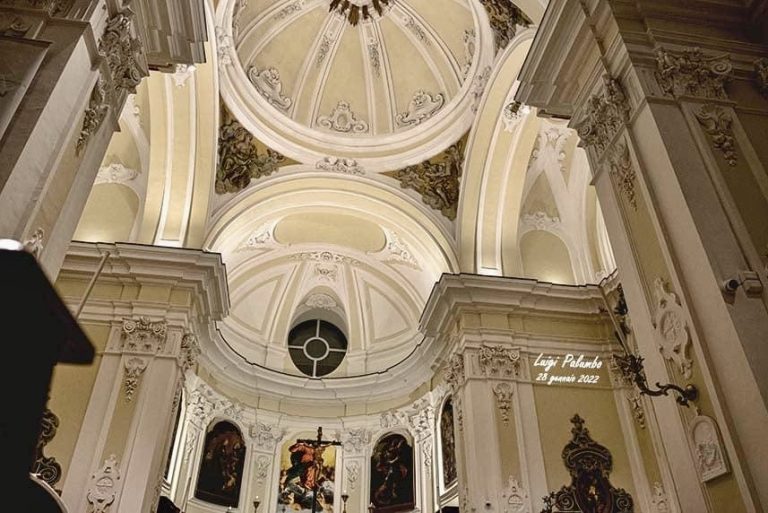
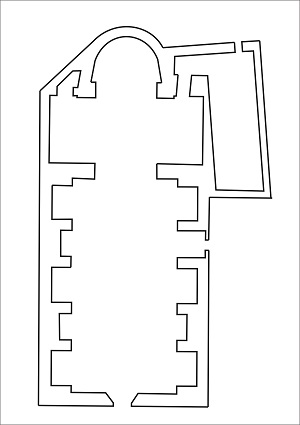
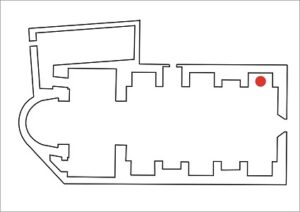
Attualmente l’edificio si presenta nella veste ricevuta dopo il terremoto del 1732 con uno sviluppo longitudinale con transetto (la cosiddetta pianta a croce latina).
Da documenti d’archivio sappiamo che la chiesa fu edificata, sotto lo sguardi vigile dell’arciprete Pietro Antonio Perillo, dai mastri muratori e fabbricatori Ciriaco di Silvia di Mercogliano e Domenico Quarata di Fontanarosa, a partire dal 1744.
L’interno venne decorato dal maestro d’ascia Michele Vigilante di Ariano, che realizzò bussola, la cantoria e la cassa dell’organo; dal maestro stuccatore e intagliatore, Gaetano Amoroso, di Miano, che realizzò i pilastri, i capitelli, i cornicioni, i festoni e gli altari laterali che in origine erano stucco; dallo scultore Nicola Massaro che realizzò gli angeli, le allegorie e i quattro evangelisti del transetto, il fonte battesimale e l’altare maggiore; e dal reggiolaro, o ceramista, Giuseppe (junior) Massa che realizzò la pavimentazione maiolicata, sostituita negli anni Cinquanta del Novecento con quella attuale.
R. M.
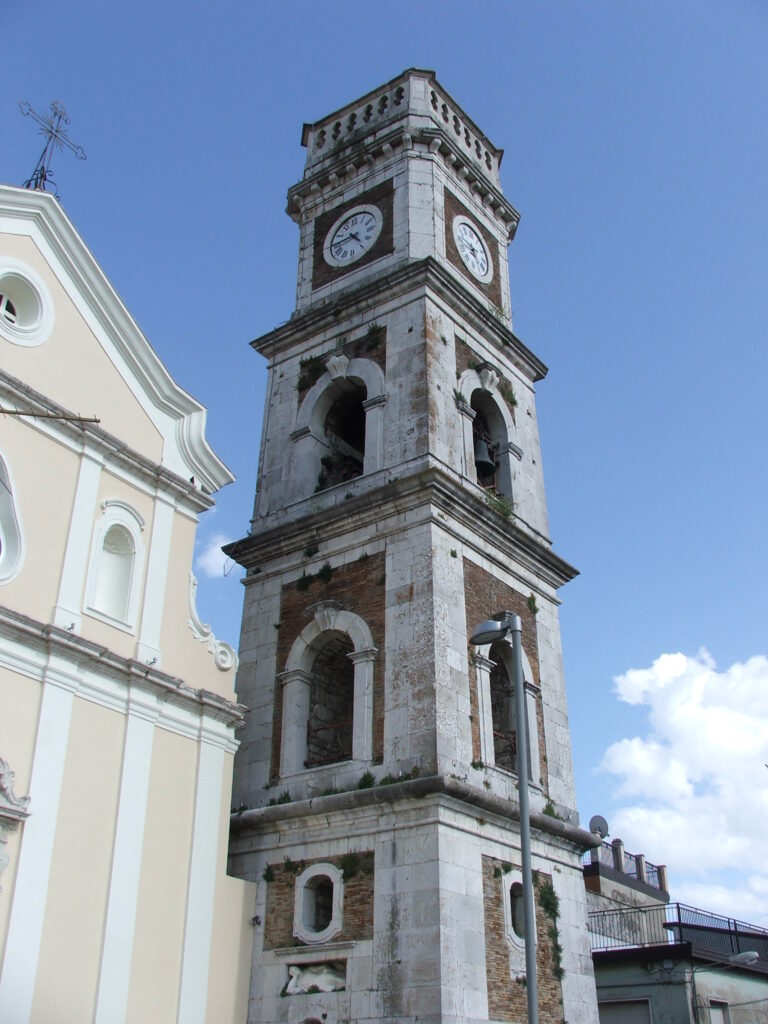
Un discorso a parte merita il campanile che si mostra in una veste classicista che riprende lo stile di Luigi Vanvitelli e difatti in passato si è creduto che il progettista fosse stato proprio il Vanvitelli. Comunque, l’edificazione venne affidata a Eligio Falcucci e, al già citato, Domenico Quarata, i quali vi lavorarono dal 1766 al 1774.
I due mastri fabbricatori non abbatterono il precedente campanile quattrocentesco, ma l’inglobarono e l’ampliarono nella nuova struttura.
Il campanile si presenta costruito in laterizi, con finiture in pietra chiara. Si sviluppa su cinque livelli scanditi da quattro cornici marcapiano, ma in origine i livelli erano soltanto tre. Mancavano gli ultimi due, quello dell’orologio e quello del parapetto finale. Al loro posto si sviluppava una cupola a cipolla che venne abbattuta nel 1874 quando venne aggiunto il livello con l’orologio, mentre il parapetto finale venne realizzato solo nel 1902, per interessamento dell’Arciprete Del Grosso e del sindaco Euplio Vitale.
R. M.