In corso

  • Storia dell’Ordine della Mercede e il Convento

    italia

    Parrocchia Santuario Maria SS. di Carpignano
    L’Ordine dei Mercedari 
    Il Convento di Carpignano 
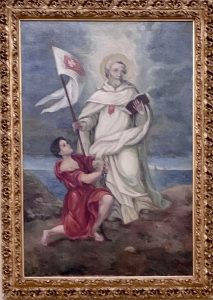
    San Pietro Nolasco 
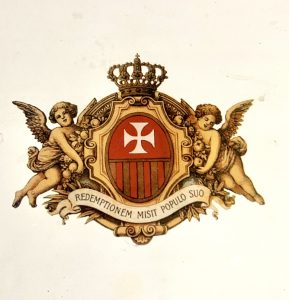
    Lo stemma dell’Ordine

    Parish Sanctuary  Maria SS. of Carpignano 
    The Order of the Mercedary

    The Convent of Carpignano
    San Pietro Nolasco
    The coat of the Order  

    L’Ordine dei Mercedari

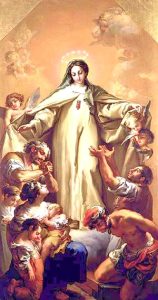
    L’Ordine di S. Maria della Mercede fu fondato a Barcellona il 10 agosto 1218, da Pietro Nolasco, con lo scopo di liberare i prigionieri cristiani ridotti in schiavitù dai musulmani o dai pagani e poi approvato, il 17 gennaio 1235, da papa Gregorio IX che impose ai religiosi la regola di Sant’Agostino come norma fondamentale. Inizialmente, l’ordine ebbe carattere laicale e militare ma nel tempo acquisì caratteristiche più spirituali, tanto che nel 1690 si inserì tra gli ordini mendicanti. Dopo l’abolizione della schiavitù, i Mercedari si dedicarono all’insegnamento e all’apostolato missionario: dopo il concilio Vaticano II, in virtù dello spirito del fondatore, i frati ripresero a contrastare le nuove forme di schiavitù di carattere politico, sociale e psicologico, secondo il principio “LIBERI PER LIBERARE”, ovvero liberare l’uomo di ogni tempo dalle schiavitù, specialmente quelle pericolose per la fede cristiana.

    Il Carisma e la spiritualità dell’Ordine

    Il Prologo delle Costituzioni del 1272, nell’istituire l’Ordine, stabiliva che i Mercedari avrebbero dovuto ispirarsi ai principi di mantenimento e sviluppo della misericordia mediante la visita e la redenzione dei cristiani caduti nel potere dei saraceni e di altri contrari alla Legge di Cristo, vivendo come figli di una vera obbedienza, sempre gioiosamente disposti a dare la loro vita, se necessario, come Gesù Cristo la diede per l’umanità. L’opera della redenzione mercedaria ha anche lo scopo di rincuorare gli schiavi nella loro sventura e ridare la speranza agli abbandonati e ai disperati, aspetto questo non indifferente dell’azione redentrice dei Mercedari. Le Costituzioni del 1986, nei numeri 13-16, così si esprimono: “Seguendo San Pietro Nolasco e illuminati dal suo carisma, noi Mercedari crediamo che la nostra missione liberatrice appartiene alla natura stessa dell’Ordine e la esercitiamo in nome della Chiesa in intima comunione con Dio e in una reale incarnazione nelle necessità degli uomini. Per compiere questa missione, spinti dalla carità, ci consacriamo a Dio con un voto particolare in virtù del quale promettiamo di dare la vita, se necessario, come Cristo l’ha data per noi, per salvare i cristiani che si trovano nell’estremo pericolo di perdere la loro fede nelle nuove forme di schiavitù. Questo voto, assunto come promessa volontaria, cosciente e assoluta, è caratteristico del nostro Ordine, ispira tutti gli atti della sua opera e qualifica l’adempimento della sua missione nella Chiesa”.

    Nuove forme di schiavitù possono riscontrarsi in una situazione sociale che comprenda le seguenti condizioni: –sia oppressiva e degradante per la persona umana;

     derivi da principi e sistemi opposti al Vangelo; ponga in pericolo la fede dei cristiani; offra la possibilità di aiutare, visitare e redimere le persone che si trovano in tale situazione.

    Il messaggio del Capitolo Generale celebrato nel maggio 1998 ha offerto particolari riflessioni sul tema di Cristo Redentore, maestro e modello del Mercedario di oggi, come lo fu per i Mercedari di ieri, specialmente per S. Pietro Nolasco.

    Il Convento di Carpignano

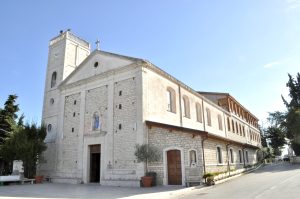
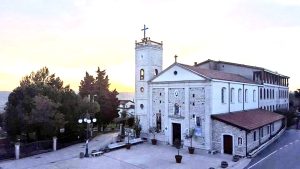
     Fondatore della comunità mercedaria carpignanese fu P. Adolfo Londei, primo superiore della comunità.

    Egli giunse a Carpignano nel febbraio 1901, insieme a fr. Ferdinando Bandiera e a P. Antonio Giuliano.

    Nei primi tempi i due abitarono in una casetta situata sulla destra della chiesa, poi, una volta decisa la costituzione di una nuova comunità, avviarono i lavori per il nuovo convento. La prima pietra fu benedetta il 17 maggio 1902 e i lavori si conclusero nel 1907.

    La costruzione, l’ampliamento e il restauro sia del convento sia della chiesa continueranno nel corso degli anni fino ai giorni nostri, grazie all’interessamento e alla determinazione dei vari parroci e Superiori che si sono succeduti negli anni. L’arrivo dei Padri Mercedari a Carpignano ha contribuito notevolmente allo sviluppo sociale e religioso locale.

    Nel 1920, i Mercedari aprirono una prima scuola per analfabeti che prevedeva ben due turni, uno serale e l’altro mattutino.

    Nel dopoguerra fu inaugurato un secondo ciclo di scuole elementari delle classi IV e V e, successivamente, con l’ultimazione della struttura del convento, si avviò la Scuola Apostolica dell’Ordine e la formazione di nuovi insegnanti, innalzando notevolmente il livello culturale locale.  

    Notevole fu anche il loro contributo per la dotazione della linea elettrica a Carpignano, da quel momento luogo anche di ritrovo e di aggregazione sportiva per la presenza di spazi verdi e, nel tempo, di campi sportivi nel grande parco del convento. 

    In tale fermento religioso e sociale, moltissime, infine, furono le vocazioni fra i giovani irpini.

     S. Pietro Nolasco

     Pietro Nolasco nacque e visse nel contesto medievale di Barcellona, in particolare nel suo porto marittimo, ove svolse, fin da giovane, il lavoro di mercante ereditato dal padre.

    Nel suo contatto con il porto di Barcellona e con le rive del Mediterraneo, egli scoprì la piaga della schiavitù che toccò profondamente il suo cuore tanto da imbarcarsi per mare con l’intento di redimere gli schiavi, investendo direttamente i suoi beni e coinvolgendo numerosi amici.

    Questo piccolo gruppo divenne poi, il 10 agosto del 1218, un vero e proprio ordine religioso e le case della Mercede sorsero in tutto il sud della Francia, in Catalogna, a Maiorca, a Valencia, ad Aragona e a Castiglia, portando il messaggio di libertà non solo per le strade polverose della penisola ma attraverso tutto il Mediterraneo.

    Nel 1235, Papa Gregorio IX confermò l’Ordine con la bolla Devotionis vestrae. Il pellegrinaggio terreno di Pietro Nolasco ebbe termine a Barcellona, nel suo convento costruito nell’arenile di Villanova, vicino al mare, il 6 maggio 1245. La Congregazione dei Riti ne approvò il culto immemoriale il 30 settembre 1628, e il 19 giugno 1655 il suo nome fu inserito nel Martirologio Romano. L’11 giugno 1664, Papa Alessandro VII estese il suo culto a tutta la Chiesa.

    Lo stemma dell’Ordine

    Lo stemma rappresenta il segno distintivo del religioso appartenente all’Ordine della Beata Maria Vergine della Mercede, da sempre portato al petto dei frati come lasciapassare sin dalle loro prime missioni redentrici.

    Gli elementi fondamentali che lo costituiscono sono lo scudo e lo stemma di Giacomo I d’Aragona.  

    Lo scudo, recante la croce bianca che campeggia sullo sfondo rosso, rappresenta la croce della cattedrale di Barcellona che il vescovo Berenguer de Palou donò quando nacque la fraternità dell’Hospitalis di S. Eulalia (cf. Bulla Devotionis Vestrae…, Perugia 17 gennaio 1235). Lo stemma di Giacomo I di Aragona, d’oro a quattro pali di rosso, testimonia il patronato e la benevolenza della casa reale spagnola all’Ordine. Questo patronato reale alla missione redentrice dell’Ordine permetteva ai frati della Mercede di tutti i tempi, dal XIII al XVIII secolo, un rispettoso andirivieni oltre le frontiere durante le missioni redentrici, vale a dire lungo i difficili itinerari, al fine di riscattare coloro che erano caduti in prigionia dei Saraceni.

    A cura dei Padri Mercedari

    The order of the Mercedary

    The Order of “S. Maria della Mercede”was founded in Barcelona on 10th August 1218 by Pietro Nolasco with the aim of freeing Christian prisoners enslaved by Muslims or pagans and then approved on 17th January 1235 by Pope Gregory IX who assigned the rule of St. Augustine to the religious as a fundamental rule. Initially the order had a secular and military character, then it became more spiritual, arriving in 1690 to be included among the mendicant orders. After the elimination of slavery, the Mercedaries dedicated themselves to the teaching and the missionary apostolate: after the Second Vatican Council, by virtue of the founder’s spirit, the friars resumed opposing the new forms of political social and psychological slavery, according to the principle LIBERI PER LIBERARE that is to free man of all times from slaveries, especially those dangerous for the Christian faith.

    The Charism and spirituality of the Order

    The Prologue of the Constitutions of 1272, in setting up the Order, established that the Mercedaries should be inspired by the principles of maintenance and development of mercy through the visit and redemption of Christians who have fallen into the power of the Saracens and others contrary to the Law of Christ, living as children of true obedience, always joyfully willing to give their life, if necessary, as Jesus Christ gave it for humanity. The work of Mercedary redemption also has the purpose of encouraging slaves in their misfortune and restoring hope to the abandoned and desperate, a not indifferent aspect of the redemptive action of the Mercedaries. The 1986 Constitutions, in numbers 13-16, express themselves as follows: “Following St. Peter Nolasco and enlightened by his charisma, we Mercedaries believe that our liberating mission belongs to the very nature of the Order and we exercise it in the name of the Church in intimate communion with God and in a real incarnation in the needs of men. To carry out this mission, driven by charity, we consecrate ourselves to God with a particular vow by virtue of which we promise to give our life, if necessary, as Christ gave it for us, to save Christians who are in extreme danger to lose their faith in the new forms of slavery. This vow, taken as a voluntary, conscious and absolute promise, is characteristic of our Order, it inspires all the acts of its work and qualifies the fulfillment of its mission in the Church”.

    The new forms of slavery are found where a social situation occurs which includes the following conditions: – it is oppressive and degrading for the human person; it derives from principles and systems opposed to the Gospel; it endangers the faith of Christians; it offers the possibility of helping, visiting and redeeming people who find themselves in such a situation. The message of the General Chapter celebrated in May 1998 offered particular reflections on the theme of Christ the Redeemer, teacher and model of today’s Mercedary, as it was for yesterday’s Mercedaries, especially St. Peter Nolasco.

    The Convent of Carpignano

    Father Adolfo Londei, the first superior of the community, was the founder of the Carpignano mercedary community. He arrived in Carpignano in February 1901, together with Father Ferdinando Bandiera and Father Antonio Giuliano.

    In the early days they lived in a small house located on the right of the church, then, once the constitution of a new community was decided, they began the construction of the new convent. The first stone was blessed on May 17th 1902 and the works were completed in 1907.

    The construction, expansion and restoration of both the convent and the church will continue over the years to the present day, thanks to the interest and the determination of the various pastors and Superiors who have succeeded one another over the years. The arrival of the Mercedary Fathers in Carpignano contributed significantly to social development and local religious.
    In 1920, the Mercedaries opened a first school for the illiterate which included two shifts, one in the evening and the other in the morning.

    After the war, a second cycle of elementary schools of classes IV and V was inaugurated and,

    subsequently, with the completion of the convent structure, the school started Apostolic of the Order and the training of new teachers, significantly raising the local cultural level.

    Their contribution was also noteworthy for the provision of the power line in Carpignano, from

    that moment also a place of meeting and sporting aggregation due to the presence of green spaces

    and, over time, of sports fields in the large park of the convent.

    Finally, in this religious and social ferment, there were many vocations among Irpini young people.


     S. Pietro Nolasco

    Pietro Nolasco was born and lived in the medieval context of Barcelona and, in particular, in its seaport where, from an early age, he carried out the work of a merchant inherited from his father.

    In his contact with the port of Barcelona and with the shores of the Mediterranean he discovered the scourge of slavery that will forever touch his heart so much that he embarked by sea with the intent of redeeming the slaves by investing his goods directly and also involving his friends.

    This community will become a religious order on August 10th 1218 and the houses of La Mercede were built throughout the south of France, in Catalonia, in Mallorca, in Valencia, in Aragon and in Castile, bringing the message of freedom not only to the dusty streets. of the Peninsula but across the Mediterranean.

    In 1235 Pope Gregory IX confirmed the Order with the bull Devotionis vestrae.

    His earthly pilgrimage ended in Barcelona, in his convent built on the beach of Villanova, near the sea, on May 6th 1245.

    The Congregation of Rites approved its immemorial cult on 30th September 1628, and on 19th June 1655 its name was inserted in the Roman Martyrology. Pope Alexander VII extended his cult to the whole Church on 11th June 1664.


    The coat of arms of the Order

    It is the distinctive sign of the religious belonging to the Order of the Blessed Virgin Mary of Mercy, the friars have always worn it on their chest as a pass along the first centuries in their redemptive missions.

    The fundamental elements are the shield and the coat of arms of James I of Aragon.

    The shield, bearing the white cross that stands out on the red background, represents the cross of the cathedral of Barcelona that the bishop Berenguer de Palou donated when the fraternity of the Hospitalis of St. Eulalia was born (cf. Bulla Devotionis Vestrae …, Perugia 17th January 1235).

    The coat of arms of James I of Aragon, in gold with four red poles, testifies to the patronage and benevolence of the Spanish royal house to the Order. This royal patronage of the redemptive mission of the Order allowed the friars of Mercede of all times, from the 13th to the 18th century, a respectful coming and going beyond the borders during the redemptive missions, that is to say along the difficult itineraries, in order to redeem those who had fallen into the captivity of the Saracens.

     By the Mercedary Fathers

  • Tavola Madonna con Bambino

    italia

    Parrocchia Santuario Maria SS. di Carpignano
    Dipinto
    Madonna con Bambino

    Autore ignoto
    Sec. XII (rimaneggiato XVII e XX sec.)

    Olio su tavola

    Parish Sanctuary Maria SS. di Carpignano

    Painting

    Madonna with Child

    Unknown author

    XII century (remodeled in XVII and XX centuries) 

    Oil on table


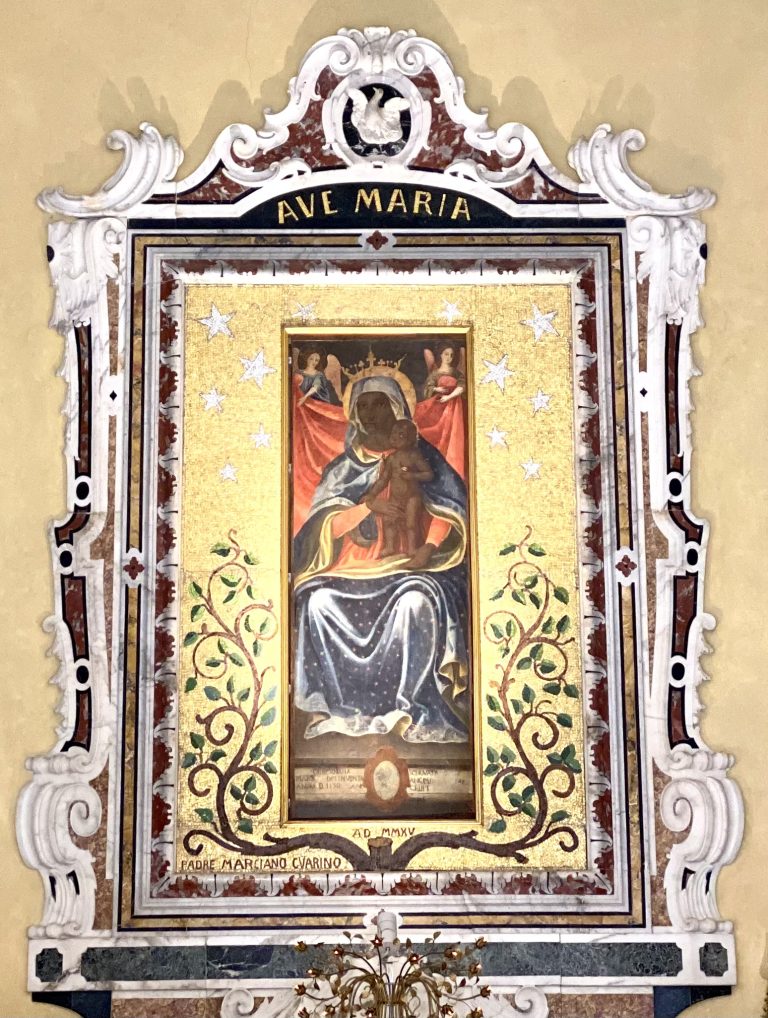
    L’opera, un dipinto ad olio su tavola di tipo bizantino, della misura di cm. 205×75, raffigura la Madonna in trono con il Bambino.

    La scena rappresentata nel dipinto che si va a descrivere è molto naturale. 

    La Vergine, incoronata, è rappresentata seduta, con un ampio mantello blu decorato a stelle ed una tunica rossa drappeggiante. Alle sue spalle due angeli che guardano lo spettatore, sorreggono un drappo rosso che dà all’insieme il tono solenne di una Maestà. La Madonna tiene ritto, dalla parte del cuore, il Bambino Gesù, nudo, che poggia i piedi sul ginocchio sinistro materno ed ha nella mano sinistra un piccolo pavone simbolo di resurrezione e rinascita, nello stesso tempo poggia la mano destra sulla mano destra della madre. Lo sguardo della Vergine è rivolto ai fedeli, quello del Bambino rivolto alla madre, entrambi i personaggi sono rappresentati con carnagione scura.

    Secondo la tradizione, che segue un topos agiografico consueto, la tavola sarebbe stata ritrovata nell’anno 1150 da alcuni pastori nel cavo di una pianta di carpine e che dopo aver tentato di portare altrove il quadro, la Madonna con segni prodigiosi, abbia voluto far capire a quei pastori che essa voleva essere venerata in questo luogo. Come a proteggere con il suo sguardo materno, dalla sommità di questa collina i tantissimi paesi irpini che si possono scorgere.

    L’ultimo restauro ha dimostrato che il supporto ligneo ha un’origine orientale e che può essere datato nel XII secolo.

    La tavola, con buona probabilità, è una delle tante opere d’arte trasportate dall’Oriente in occasione delle varie Crociate che, nel nostro caso, è la seconda svoltasi tra il 1145 ed il 1149.

    L’opera è stata rimaneggiata più volte nel corso dei secoli tanto che non si conosce l’aspetto originale della Madonna in quanto, nel 1639, l’immagine mariana venne totalmente ridipinta nelle forme che vediamo oggi, come attestava un’iscrizione alla base dell’immagine (CRYSPIGNANA MAT [er]/ DEI INVENTA/ ANNO D(omini) 1150/ [sul lato destro] RENOVATA E[x] VOTO/ ANGEL [o/a]…A .. NO/ GRUPT[a  A(nno) D(omini) 16]39, ovvero «La Madre di Dio di Carpignano rinvenuta nell’anno del Signore 1150, (fu) restaurata per voto di Angelo (o Angela) .. a .. no di Grotta nell’anno del Signore 1639), oggi parzialmente rimaneggiata.

    Successivamente la tavola è stata restaurata nel 1801, nel 1871, nel 1909, nel 1950, nel 1981 e infine, nel 2004.

    In particolare, va ricordato che il restauro realizzato nel 1909 fu effettuato dal pittore Vincenzo Volpe, quello del 1981 dall’artista francescano Padre Andrea Martini che, per i gravi danni causati dal terremoto del 1980, ne ha modificato notevolmente l’immagine seicentesca; il restauro effettuato nel 2004 ad opera del maestro Umberto Piezzo di Napoli il quale ha cercato di recuperare i frammenti originali dell’opera e ricostruire, nel limite del possibile, l’immagine originale seicentesca.

    Il supporto dell’opera, composta da una sola asse di legno a sviluppo verticale e proveniente da un albero di noce del diametro di almeno un metro, può essere datato in base alla tecnica costruttiva con la quale è stato realizzato nel XII secolo; di contro, l’immagine, in base alla tecnica pittorica e alla tipologia mariana, tralasciando le ridipinture dei secoli successivi, può essere datata nel XVII secolo.                                                    


     R. M.


    The work, an oil painting on wood, measuring 205X75 cm, depicts an enthroned Madonna with the Child.

    The scene represented in the painting that is going to be described is very natural.

    The crowned Virgin is shown seated, with a large star-decorated blue cloak and a red draping tunic. Behind her two angels who look at the viewer hold up a red cloth that gives the whole the solemn tone of a Majesty. She has her naked son in her hands, the right hand is placed at the height of the Child’s groin while the left is placed under the left foot of the Child who, on the right side of the table, appears erect on the left knee of the mother and holds, in his left hand, a small peacock symbol of resurrection and rebirth; at the same time, he rests his right hand on his mother’s right hand. The Virgin’s gaze is turned to the faithful, that of the Child turned to the mother, both characters are represented with dark complexion.

    According to the legend, which follows a usual hagiographic topos, the table was found in the year 1150 by some shepherds in the hollow of a hornbeam plant and that after trying to bring

    elsewhere the picture, the Madonna with prodigious signs, wanted to make those shepherds understand that she wanted to be venerated in this place. As to protect with her maternal gaze from

    top of this hill the many Irpinia villages that can be seen.

    The latest restoration has shown that the wooden support has an oriental origin and that it can be dated to the 12th century.

    In all probability the table is one of the many works of art transported from the East on the occasion of the various Crusades which, in our case, is the second one held between 1145 and 1149.

    The work has been remodeled several times over the centuries, so much so that the original appearance of the Madonna is not known as, in 1639, the Marian image was totally repainted in the forms we see today, as attested by an inscription at the base of the image (CRYSPIGNANA MAT [er] / DEI INVENTA / ANNO D (omini) 1150 / [on the right side] RENOVATA E [x] VOTE / ANGEL [o / a] .. A .. NO / GRUPT [a A (nno ) D (omini) 16] 39, that is « The Mother of God of Carpignano found in the year of the Lord 1150, (was) restored by vote of Angelo (or Angela) .. a .. no of Grotta in the year of the Lord 1639), now partially remodeled.

    Subsequently the table was restored in 1801, 1871, 1909, 1950, 1981 and, finally, in 2004.

    In particular, it should be remembered that the restoration made in 1909 was carried out by the painter Vincenzo Volpe, that in 1981 by the Franciscan Father artist Andrea Martini who, due to the serious damage caused by the 1980 earthquake, has considerably modified the seventeenth-century image; the restoration carried out in 2004 by the master Umberto Piezzo from Naples who tried to recover the original fragments of the work and reconstruct, as far as possible, the original seventeenth-century image.

    The support of the work, composed of a single plank of wood with vertical development and coming from a walnut tree with a diameter of at least one meter, can be dated – based on the construction technique with which it was built – to the 12th century; on the other hand, the image, based on the painting technique and the Marian typology, leaving out the repainting of the following centuries, can be dated to the 17th century.

    R. M.

  • Altare

    italia

    Parrocchia Santuario Maria SS. di Carpignano

    Altare

    Egidio Iovanna

    Sec. XXI

    Marmi policromi

    Parish Sanctuary Maria SS. di Carpignano

    Altar

    Egidio Iovanna

    XXI century

    Polychrome marbles

    L’altare cubico è composto da un piano basamento, in marmo bianco di Carrara, e da un piano in onice. I due materiali, poggiati l’uno sull’altro, sono separati da una crepa o fessura che, secondo l’artista, richiama le crepe e le fessure della roccia delle montagne Maalula, in Siria, in cui in passato si erano rifugiati i cristiani e i martiri durante le varie persecuzioni. Il significato è chiaro: come le fessure delle rocce sono servite da rifugio per gli uomini, così il sacrificio eucaristico compiuto sull’altare deve essere il rifugio per l’anima del cristiano. Sul frontale della parte superiore dell’altare, quella in onice, è inciso un tralcio di vite con una foglia ed un grappolo d’uva. L’opera è stata realizzata dallo scultore di Fontanarosa Egidio Iovanna, il quale, insieme ai suoi collaboratori, ispirandosi all’antichissimo altare della cittadina siriana di Maalula, lo ha ideato e scolpito insieme agli altri elementi che compongono gli arredi sacri dell’intero complesso scultoreo di seguito descritti ossia l’ambone, il tabernacolo, la fonte battesimale.


    M. V.

    The cubic altar is made up of a base top, in white Carrara marble, and a top in onyx. The two materials, resting one on top of the other, are separated by a crack or fissure which, according to the artist, recalls the cracks and crevices of the rock of the Maalula mountains, in Syria, where in the past Christians and martyrs had taken refuge during the various persecutions. The meaning is clear: just as the cracks in the rocks served as a refuge for men, so the Eucharistic sacrifice performed on the altar must be the refuge for the Christian’s soul. On the front of the upper part of the altar, the one in onyx, a vine branch with a leaf and a bunch of grapes is engraved. The work was created by the sculptor of Fontanarosa Egidio Iovanna, who, together with his collaborators, inspired by the ancient altar of the Syrian town of Maalula, designed and sculpted it together with the other elements that make up the sacred furnishings of the entire complex sculptural described below, namely the ambo, the tabernacle, the baptismal font.

    M. V.

  • Tabernacolo e basamento marmoreo

    italia

    Parrocchia Santuario Maria SS. di Carpignano

    Tabernacolo sec. XX

    Basamento marmoreo sec. XXI

    Egidio Iovanna

    Bronzo dorato e marmi policromi

    Parish Sanctuary Maria SS. di Carpignano

    Tabernacle XX century

    Marble base XXI century

    Egidio Iovanna

    Gilded bronze and polychrome marbles

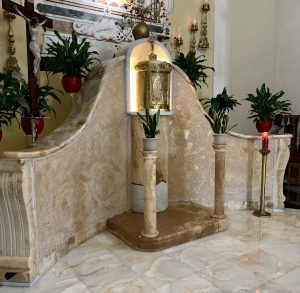
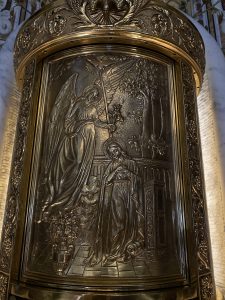
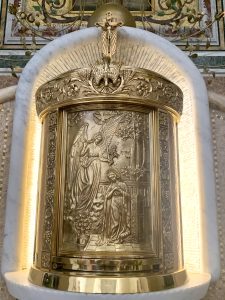
    Il Tabernacolo in bronzo dorato e di forma cilindrica, sormontato da una croce, finemente cesellato e dorato, mostra sulla porticina la raffigurazione dell’Annunciazione realizzata a sbalzo.

    Fu realizzato nel 1950 e impiantato per la prima volta sull’allora Altare maggiore in occasione della celebrazione dell’ottavo centenario del ritrovamento del quadro. L’incisione di un nome alla base attesta che fu commissionato negli Stati Uniti (USA) e donato da Giovannino Annese, emigrato da Carpignano negli USA.

    Durante l’ultimo restauro dell’interno dell’intera chiesa nel 2011, il tabernacolo ha trovato collocazione in una bellissima edicola di marmo bianca, sorretta da una colonna circolare di marmo bianco sovrastata da uno di onice. L’opera, realizzata dall’artista Egidio Iovanna, riprende i motivi e i materiali usati per l’altare e ambone.

    Sulla parte di colonna realizzata in onice sono incise tre spighe di grano, dono di Dio, simbolo del lavoro e della fatica umana. Il seme del grano ogni anno muore per rinascere puntualmente a nuova vita, salvando l’uomo dalla morte per fame.

    Il chicco di grano è una metafora visibile e concreta: da un lato il suo aspetto inerme e la sua morte apparente, dall’altro la potenza di vegetale racchiusa in esso lo identificano come fonte di vita: morendo, infatti, si moltiplica.

    Nella Bibbia molti sono i passi che fanno riferimento al grano, in particolar modo nei Vangeli dove questa pianta addomesticata dall’uomo non è solo dono divino e segno di abbondanza ma diventa, simbolicamente, alimento per l’anima. Il pane ottenuto dal grano diventa il corpo stesso di Cristo e, con il vino, il suo sangue, simbolo eucaristico per eccellenza.

    Ad abbellire ulteriormente l’opera, venne realizzata una vela ai due lati dell’intera colonna e nel 2016 fu impreziosita da un mosaico dorato raffigurante tralci di uva e spighe di grano, realizzato dal Maestro d’arte contemporaneo Edmondo Campana.

    Sonia Bruno

    The Tabernacle in gilded bronze and cylindrical in shape, finely surmounted by a cross, chiseled and gilded, shows on the door the representation of the Annunciation made in overhang.

    It was built in 1950 and installed for the first time on the then High Altar in occasion of the celebration of the eighth centenary of the discovery of the painting. The engraving of a name at the base attests that it was commissioned in the United States (USA) and donated by Giovannino Annese, who emigrated from Carpignano to the USA.

    During the last restoration of the interior of the entire church in 2011, the tabernacle found a place in a beautiful white marble aedicule, supported by a circular column of white marble topped by one of onyx. The work, created by the artist Egidio Iovanna, takes up the motifs and materials used for the altar and ambo.

    On the part of the column made of onyx three ears of wheat are engraved, a gift of God, symbol of work and human fatigue. The wheat seed dies every year to be promptly reborn to new life, saving the man of starvation.

    The grain of wheat is a visible and concrete metaphor: on the one hand its helpless appearance and his apparent death, on the other hand the plant power contained in it identify him as a source of life: in dying, in fact, it multiplies.

    In the Bible there are many passages that refer to wheat, especially in the Gospels where this plant domesticated by man is not only a divine gift and a sign of abundance but symbolically becomes food for the soul. The bread obtained from the grain becomes the very body of Christ and, with the wine, his blood, the Eucharistic symbol for excellence.

    To further embellish the work, a sail was created on both sides of the entire column and in 2016 it was embellished with a golden mosaic depicting grape shoots and ears of grain, created by the contemporary art master Edmondo Campana.


    Sonia Bruno

  • Ambone

    italia

    Parrocchia Santuario Maria SS. di Carpignano

    Ambone

    Egidio Iovanna 

    Sec. XXI

    Marmi policromi

    Parish Sanctuary Maria SS. di Carpignano

    Ambo

    Egidio Iovanna

    XXI century

    Polychrome marbles

    L’ambone presenta un basamento in marmo bianco di Carrara, mentre l’ambone vero e proprio è in onice. Sul frontale sono incisi i simboli stilizzati dei quattro Evangelisti: un uomo per Matteo, un leone per Marco, un bue per Luca ed un’aquila per Giovanni.

    In effetti, tale arredo sacro ha pari dignità ed importanza rispetto all’altare
    perché l’uno richiama l’altro in quanto l’ambone è il luogo da cui si proclama la Parola di Dio e l’importanza della Sacra Scrittura coinvolge inevitabilmente anche il luogo da dove essa viene proclamata.

    Tanto ciò è vero che, nell’introduzione alla sezione dedicata all’ordinamento delle Letture della Messa, si chiede espressamente che il luogo da cui viene proclamata la Parola di Dio risponda alla dignità della Parola stessa e richiami, dunque, il rapporto con l’altare.

    D’altronde, è dall’ambone che il Verbo viene evocato e sull’altare esso “si
    fa carne”
    Per tale considerazione si è ritenuto, non solo, di realizzarlo nello stesso materiale, ossia in marmo bianco di Carrara ed in onice di Gesualdo, ma di collocarlo sulla destra, in uno spazio alquanto sopraelevato per non intercettare visivamente l’altare.

    M. V.

    The ambo has a base in white Carrara marble, while the actual ambo is in onyx. The stylized symbols of the four Evangelists are engraved on the front: a man for Matthew, a lion for Mark, an ox for Luke and an eagle for John.

    In fact, this sacred furniture has equal dignity and importance with respect to the altar because one recalls the other since the ambo is the place from which the Word of God is proclaimed and the importance of Sacred Scripture inevitably also involves the place from where it is proclaimed.

    This is so true that, in the introduction to the section dedicated to the organization of the Readings of the Mass, it is expressly requested that the place from which the Word of God is proclaimed respond to the dignity of the Word itself and therefore recall the relationship with the altar.

    However, it is from the ambo that the Word is evoked and on the altar it “becomes flesh”For this consideration it was decided not only to make it in the same material, namely white Carrara marble and Gesualdo onyx, but to place it on the right, in a somewhat raised space so as not to visually intercept the altar.

    M. V.

  • Fonte Battesimale

    italia

    Parrocchia Santuario Maria SS. di Carpignano

    Fonte battesimale

    Egidio Iovanna

    Sec. XXI

    Marmi policromi e metallo

    Parish Sanctuary Maria SS. di Carpignano

    Baptismal Font

    Egidio Iovanna

    XXI century 

    Polychrome marble and metal

    Il nuovo fonte Battesimale della Chiesa è stato concepito e costituito idealmente da elementi geometrici solidi semplici: un cilindro incavato per la base e un cono per la copertura. 

    L’elemento di base essenziale è il cerchio, una figura geometrica piana, simbolo di rinascita di perfezione, di omogeneità, di assenza di divisione. Rappresenta la manifestazione universale dell’Essere Unico Non-Manifestato, il principio e la fine. Il cilindro è la proiezione verso l’alto di questa figura perfetta.

    Sul cilindro è poi poggiato un cono che vuole essere l’evoluzione di un triangolo ruotato su stesso. È fin troppo noto che il triangolo è il simbolo tradizionale della Santissima Trinità, le tre persone, Padre, Figlio e Spirito Santo, nel cui nome viene attuato il battesimo.    

    Il cilindro, similmente agli altri elementi scultorei della Chiesa, è realizzato in marmo ed onice, mentre il cono, sormontato da una croce, è in metallo ramato.

    M. V.

    The new baptismal font of the Church was conceived and ideally made up of simple solid geometric elements: a hollow cylinder for the base and a cone for the cover.

    The essential basic element is the circle, a flat geometric figure, a symbol of the rebirth of perfection, of homogeneity, of absence of division. It represents the universal manifestation of the One Unmanifested Being, the beginning and the end.

    The cylinder is the upward projection of this perfect figure.

    A cone is then placed on the cylinder which wants to be the evolution of a triangle rotated on itself. It is all too well known that the triangle is the traditional symbol of the Holy Trinity, the three persons, Father, Son and Holy Spirit, in whose name baptism is carried out.

    The cylinder, similarly to the other sculptural elements of the Church, is made of marble and onyx, while the cone, surmounted by a cross, is in copper-plated metal.

    M. V.

  • Scultura San Pietro Nolasco

    italia

    Parrocchia Santuario Maria SS. di Carpignano

    Scultura

    San Pietro Nolasco

    Ambito italiano

    Sec. XX

    Legno scolpito e dipinto

    Parish Sanctuary Maria SS. di Carpignano

    Sculpture

    San Pietro Nolasco

    Italian area

    XX century

    Carved Wood

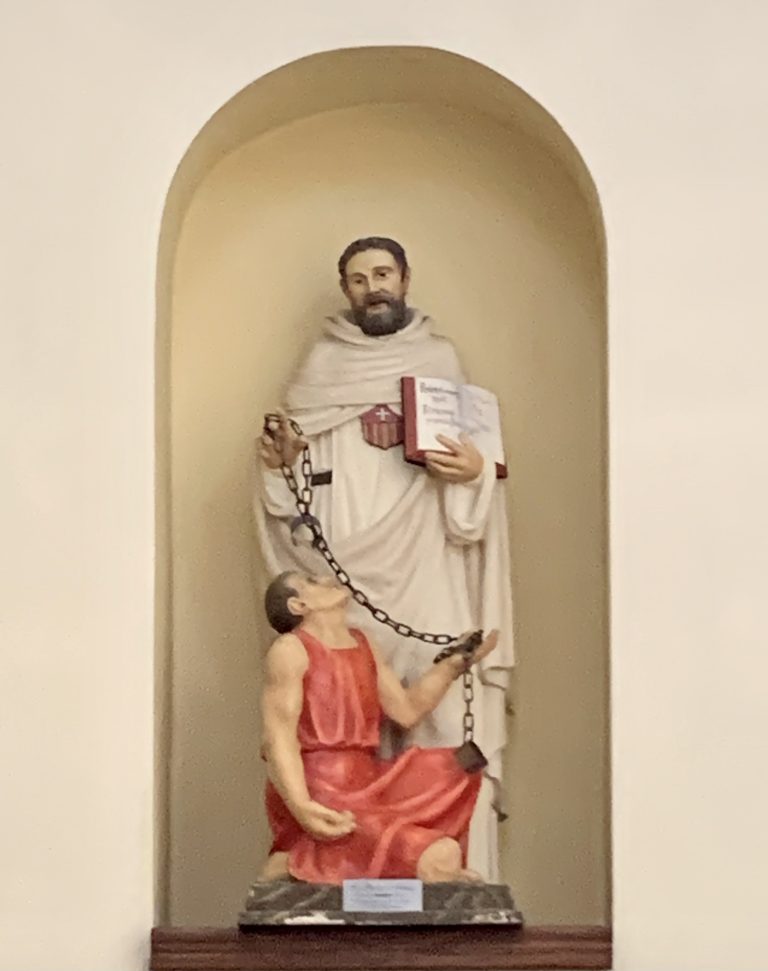
    La scultura, raffigurante il santo fondatore dell’ordine, San Pietro Nolasco, proviene da uno dei conventi italiani soppressi dell’ordine mercedario. Fu trasportata a Carpignano durante gli anni Ottanta del Novecento per interessamento dell’allor superiore del convento Padre Pasquale Pasquariello.

    Il santo spagnolo è qui raffigurato con gli attributi più significativi della sua vita: l’abito con lo stemma dell’ordine, le catene infrante, il libro della Bibbia aperto con un verso del salmo 110: “Redemptiónem misit pópulo suo” (Ha mandato la redenzione al suo popolo), un ex schiavo ai piedi del Santo.

    Biografia di San Pietro Nolasco

    Pietro Nolasco nacque e visse nel contesto medievale di Barcellona ed, in particolare nel suo porto marittimo ove svolse, fin da giovane, il lavoro di mercante, ereditato da suo padre. Nel suo contatto con il porto di Barcellona e con le rive del Mediterraneo scoprì la piaga della schiavitù che toccherà per sempre il suo cuore e lo spingerà ad imbarcarsi con l’intento di redimere gli schiavi investendo direttamente i suoi beni e coinvolgendovi anche i suoi amici.  Nacque così la “Mercede” come piccola comunità di fratelli redentori con lo scopo di raccogliere le elemosine  “per redimere” gli schiavi. Questa comunità diventerà un ordine religioso il 10 agosto del 1218.

    Le case della Mercede sorsero in tutto il sud della Francia, in Catalogna, a Maiorca, a Valencia, ad Aragona ed a Castiglia, portando il messaggio di libertà non solo per le strade polverose della Penisola ma attraverso il Mediterraneo.  Nel 1235, il Papa Gregorio IX confermò l’Ordine con la bolla Devotionis vestrae. Il suo pellegrinaggio terreno ebbe termine a Barcellona, nel suo convento costruito nell’arenile di Villanova, vicino al mare, il 6 maggio 1245. La Congregazione dei Riti ne approvò il culto il 30 settembre 1628, e il 19 giugno 1655 il suo nome fu inserito nel Martirologio Romano. Il papa Alessandro VII estese il suo culto a tutta la Chiesa l’11 giugno 1664.


    A cura dei Padri Mercedari

    The sculpture, depicting the founding saint of the order, San Pietro Nolasco, comes from one of the suppressed Italian convents of the mercedary order. It was transported to Carpignano during the eighties of the twentieth century by the interest of the then superior of the convent Father Pasquale Pasquariello.

    The Spanish saint is depicted here with the most significant attributes of his life: the dress with the coat of arms of the order, the broken chains, the book of the Bible opened with a verse from Psalm 110: “Redemptiónem misit pópulo suo” (He sent redemption to his people), a former slave at the feet of the Saint.

     Biography of San Pietro Nolasco

     Pietro Nolasco was born and lived in the medieval context of Barcelona       and, in particular in its seaport where, from an early age, he carried out the work of a merchant, inherited from his father. In his contact with the port of Barcelona and with the shores of the Mediterranean he discovered the scourge of slavery that will forever touch his heart and push him to embark with the intent of redeeming the slaves by investing his goods directly and also involving his friends. Thus, the “Mercede” was born as a small community of redeeming brothers with the aim of collecting alms “to redeem” the slaves. This community will become a religious order on 10th August 1218.

    The houses of La Mercede sprang up throughout southern France, Catalonia, Mallorca, Valencia, Aragon and Castile, carrying the message of freedom not only to the dusty streets of the Peninsula but across the Mediterranean. In 1235, Pope Gregory IX confirmed the Order with the bull Devotionis vestraeHis earthly pilgrimage ended in Barcelona, in his convent built on the beach of Villanova, near the sea, on 6th May 1245. The Congregation of Rites approved its cult on 30th September 1628, and on 19th June 1655 its name was inserted in the Roman Martyrology. Pope Alexander VII extended his cult to the whole Church on 11th June 1664.


    By the Mercedary Fathers

  • Statua San Lorenzo

    italia

    Parrocchia Santuario Maria SS. di Carpignano
    Scultura
    San Lorenzo martire

    Artista sconosciuto
    Ambito meridionale
    Sec. XIX-XX

    Cartapesta

    Parish Sanctuary  SS. Maria of Carpignano

    Sculpture

    Saint Lawrence martyr

    Unknow artist

    Southern area

    XIX-XX centuries

    Papier-mache

    Il culto di San Lorenzo Martire non è molto diffuso nel territorio grottese. Fu introdotto a Carpignano dai Padri Mercedari, i quali riconoscono e attribuiscono una protezione particolare a San Lorenzo, in quanto, la Santa Sede riconobbe ufficialmente l’ordine della Mercede, il 10 Agosto 1218, anniversario della festa di San Lorenzo.

    Non si conosce la provenienza originale della statua, forse uno dei conventi soppressi dell’Ordine, ma la sua presenza nella Chiesa di Carpignano è documentata a partire dall’agosto 1935, quando nel diario del
    convento, tra le manifestazioni relative alla festa del Santo è documentata
    “una processione con la statua del Santo”. Cosa non attestata per l’anno
    precedente.

    La scultura, in cartapesta, riproduce il santo diacono in piedi con i paramenti sacri del proprio ordine sacro, la dalmatica. Con la mano destra regge la graticola, l’attributo iconografico che ricorda il suo
    martirio, mentre con la sinistra stringe un ramo di palma, attributo proprio
    dei santi martiri.  

    R. M.

    The cult of Saint Lawrence Martyr is not very widespread in the Grotesque area. It was introduced to Carpignano by Mercedary Fathers, who recognized and attributed a particular protection to Saint Lawrence, as on 10th August 1218, the anniversary of the religious feast of Saint Lawrence, the Saint See officially recognized the order of the Mercede.

    The original provenance of the statue is unknown, perhaps one of the Order’s suppressed convents,

    but its presence in the Church of Carpignano is documented starting from August 1935, when in the diary of the convent, among the events relating to the feast of the Saint “a procession with the statue of the Saint ” is documented. What is not certified for the previous year.

    The papier-mache sculpture reproduces the holy deacon standing with the sacred vestments of his own sacred order, the dalmatic. With his right hand he holds the grill, the iconographic attribute that remembers his martyrdom, while with his left hand he holds a palm branch, an attribute of the saints martyrs.

  • Dipinto Madonna con Bambino fra due Santi

    italia

    Parrocchia Santuario Maria SS. di Carpignano

    Dipinto

    Odoardo Fischetti

    La Madonna con Bambino tra i Santi Apostoli Giacomo il minore e Filippo

    Sec. XIX (dat. e firmato 1823) 

    Olio su tela

    Parish Sanctuary Maria SS. di Carpignano

    Painting

    Odoardo Fischetti

    The Madonna and Child with the Holy Apostles James the younger and Philip

    XIX century (dated and signed 1823)

    Oil painting on canvas

    Il dipinto raffigura la Madonna nella parte alta della tela, indossa un abito rosaceo, un mantello celeste, e sulla testa, legato sulla fronte, un velo bianco. In braccia tiene il Bambino Gesù che è raffigurato nell’atto di benedire.

    I due santi, in abito bianco, sono scalzi: il primo, a destra, ha un aspetto giovanile e reca nella mano sinistra un bastone nodoso; il secondo, a sinistra, ha un aspetto più vetusto e reca con entrambe le mani una croce che poggia sulla spalla sinistra. Entrambi sono in estasi e guardano la Madonna. Ai piedi dei due Santi sono presenti alcuni manoscritti srotolati.

    In basso, tra i due Santi, è raffigurato lo stemma della famiglia napoletana D’Aulisio Garigliota, probabili committenti dell’opera.

    L’opera non è di provenienza locale ma è stata collocata nella Chiesa di Carpignano dai Padri Mercedari.

    La tela, firmata “Odoardo Fischetti” e datata nell’anno 1823, raffigura la Madonna con Bambino, seduta sulle nuvole, tra gli apostoli Filippo e Giacomo.

    Odoardo Fischetti, pittore napoletano documentato tra il 1799 e il 1824, si è occupato principalmente di raffigurazioni storiche pur avendo realizzato vedute e quadri a soggetto religioso e mitologico.

    Stilisticamente l’opera, datata al 1823, è vicino alla corrente neoclassica francese.

    R. M.

    The painting depicts the Madonna in the upper part of the canvas, wearing a pink dress, a light blue cloak, and on her head, tied on the forehead, a white veil. In her arms she holds the Baby Jesus who is depicted in the act of blessing.

    The two saints, in white robes, are barefoot: the first, on the right, has a youthful appearance and carries a gnarled stick in his left hand; the second, on the left, has a more ancient aspect and with both hands bears a cross that rests on the left shoulder. Both are in ecstasy and look at the Madonna. At the foot of the two saints there are some unrolled manuscripts.

    Below, between the two Saints, the coat of arms of the Neapolitan D’Aulisio Garigliota family is depicted, probable clients of the work.

    The work is not of local origin but was placed in the Church of Carpignano by the Mercedary Fathers.

    The canvas, signed “Odoardo Fischetti” and dated in the year 1823, depicts the Madonna and Child, sitting on the clouds, between the apostles Philip and James.

    Odoardo Fischetti, a Neapolitan painter documented between 1799 and 1824, has mainly dealt with historical representations despite having created views and paintings with religious and mythological subjects.

    Stylistically, the work, dated to 1823, is close to the French neoclassical current.

    R. M.

  • Dipinto Santa Restituta

    italia

    Parrocchia Santuario Maria SS. di Carpignano

    Dipinto

    Il trasporto del corpo di Santa Restituta

    Ambito campano

    Sec. XIX

    Olio su tela

    Parish Sanctuary Maria SS. di Carpignano

    Painting

    The transport of the body of S. Restituta

    Italian area

    XIX century

    Oil painting on canvas

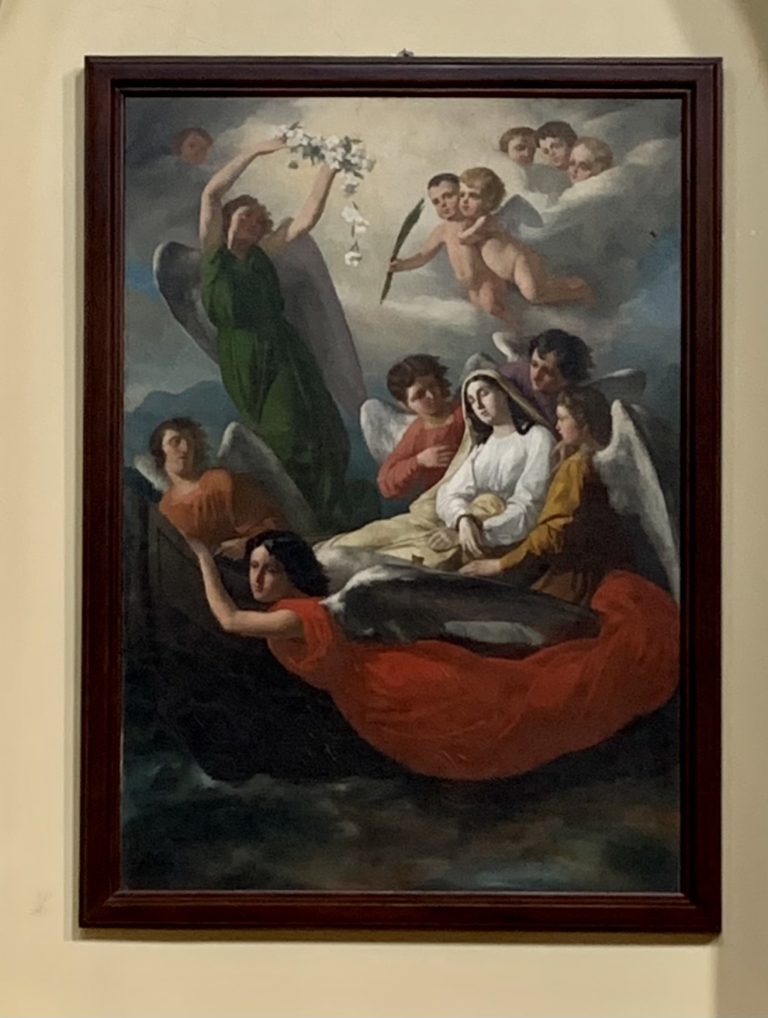
    La tela, opera di un anonimo pittore, riproduce il trasporto del corpo di S. Restituta. La Santa, ormai defunta, è posta all’interno della barca dove è sostenuta da tre angeli. Un quarto ed un quinto angelo conducono l’imbarcazione, mentre un sesto angelo è raffigurato mentre sistema una corona di fiori sulla testa della Santa. Sullo sfondo sono raffigurati due fanciulli nudi che sorreggono la palma del martirio, mentre altri quattro angeli, nella forma di teste alate, osservano la scena. Per stile l’opera può essere datata nella seconda metà del XIX° secolo, non è di provenienza locale ma è stata collocata nel Santuario dai Padri Mercedari. Restituta era una ragazza di origine africana, vissuta tra la fine del III° e l’inizio del IV° secolo. Si formò sotto il vescovo di Cartagine San Cipriano. Nell’anno 304, durante la persecuzione di Diocleziano, fu arrestata, processata e condannata a morte insieme ad altri 50 cristiani.

    Una Passiones del X° secolo racconta che la vergine, una volta condannata a morte, venne legata e posta su di una barca carica di stoppa e intrisa di resina e pece. La barca venne portata a largo dai carnefici e data alle fiamme. La ragazza rimase illesa mentre le fiamme inghiottirono l’imbarcazione dei suoi carnefici. Restituta ringraziò il Signore per averla salvata e gli chiese di accedere alla pace eterna e di tanto venne esaudita.

    Una tradizione millenaria racconta che la barca su cui viaggiava il corpo della Santa era guidata dagli angeli all’isola di Ischia. Qui un angelo avvertì una matrona cristiana di nome Lucina che, recatasi in spiaggia, ritrovò l’imbarcazione arenata con il copro della Santa. Subito richiamò la popolazione dell’isola e insieme diedero sepoltura al corpo della martire nel sito dove oggi è il Santuario dedicato alla Santa, a Lacco Ameno.

    R. M.

    The canvas, the work of an anonymous painter, reproduces the transport of the body of S. Restituta. The saint, now defunct, is placed inside the boat where she is supported by three angels. A fourth and fifth angel lead the boat, while a sixth angel is depicted placing a crown of flowers on the Saint’s head. In the background two naked children are depicted holding the palm of martyrdom, while four other angels, in the form of winged heads, observe the scene. In style, the work can be dated to the second half of the nineteenth century, it is not of local origin but was placed in the Sanctuary by the Mercedary Fathers. Restituta was a girl of African origin, who lived between the end of the third and the beginning of the fourth century. She was formed under the bishop of Carthage San Cipriano. In the year 304, during the persecution of Diocletian, she was arrested, tried and sentenced to death along with 50 other Christians.

    A Passiones from the 10th century tells that the virgin, once sentenced to death, was tied and placed on a boat loaded with tow and soaked in resin and pitch. The boat was carried offshore by the executioners and set on fire. The girl was unharmed as the flames engulfed the boat of her executioners. Restituta thanked the Lord for having saved her and asked him to have access to eternal peace and she was granted so much.

    A millenary tradition tells that the boat on which the Saint’s body travelled was guided by angels to the island of Ischia. Here an angel warned a Christian matron named Lucina who, having gone to the beach, found the boat stranded with the body of the Saint. He immediately attracted the population of the island and together they buried the body of the martyr on the site where today is the Sanctuary dedicated to the Saint, in Lacco Ameno.

    R. M.